Showing posts with label conservation. Show all posts

Sunday, January 13, 2008

ilovemountains.org


What's not to love about mountains? Not only are they breathtaking to look at, their geography makes our region unique and they provide habitat for wildlife, recreational opportunities, and countless resources that are important to our economy.

The folks over at ilovemountains.org definitely love themselves some mountains. So much so that they are doing everything they can to protect mountains that are at risk of being levelled in coal producing areas. Nothing against coal production-coal is one of those important resources we need-but there is a problem with certain methods of how it is extracted.

You guessed where I am going with this, right? Yep, Mountain Top Removal. Well, the ilovemountains.org website has a handy-dandy tool designed to encourage electricity conservation by showing on a zip-code basis where YOUR electricity originates.

They have linked research of MTR sites, coal burning power plants, and your power meter to show directly how our electricity consumption is linked to resource extraction in the mountains.

Go ahead, we'll wait while you check it out: http://www.ilovemountains.org/myconnection/

"Clean coal" is a buzz word on the lips of many people these days. You hear it in Congress, read about it in newspapers, and you've probably even seen commercials about it on television. Those of us from coal producing areas know coal isn't and can never be truly "clean". Ever. Somewhere, a price is paid whether it is at the mine, the prep plant, or the power plant. Contrary to what the fancy commercials want us to believe, coal is inherently a dirty product from start to finish. And it's important that the public gets the real story.

Coal is and will remain a vital part of our economy until a suitable alternative is found. Because of that, it will continue to have impacts, both positive and negative, on the communities where it is produced. Consumers can lessen the impact of coal by turning off a light, turning off the television (or computer when not reading Hillbilly Savants!), or adjusting the thermostat a few degrees to save energy.

Here are some websites with similar information on energy consumption:

U.S. Department of Energy, Lawrence Berkley Lab Home Energy Saver - Designed to help consumers identify the best ways to save energy (and money) in their homes.

U.S. Environmental Protection Agency Personal Emissions Calculator - Short survey to estimate your personal greenhouse gas emissions.

U.S. Environmental Protection Agency Power Profiler - shows on a zip-code basis the energy mix (coal, nuclear, hydro, etc..) of your utility company

And to part, here's a video produced by ilovemountains.org on MTR and energy consumption in America featuring Woody Harrelson and Willie Nelson:

Tuesday, November 06, 2007

Stream Buffer Zone Rule under Review: Act Now to Protect our Streams

Thanks to Kathy Selvage, Vice President of Southern Appalachian Mountain Stewards, for bringing this important issue to our attention. Below is her explanation of why this issue is critically important to those who care about protecting our natural resources.
--April

The Stream Buffer Zone Rule is a 1983 rule which prohibits coal mining activities from disturbing areas within a 100 ft. buffer of an intermittent or perennial stream. It states that coal mining activities cannot disturb these areas unless water quality and quantity will not be adversely impacted.

On August 24, 2007, the Administration proposed a change or clarification in the Stream Buffer Zone. Many people now fear the stream buffer zone rule will totally disappear leaving nothing to protect our stream beds and their headwaters from having mine waste dumped in them.

How important is water today? Just ask the city of Atlanta, Georgia. Given that the region is in a drought situation, our water resources, the health of the streams, and the health of the watersheds are vitally important to all of us.

Purity of water should recognize no political boundaries. We don’t often ask if one is a Democrat or Republican before we offer water. The quality of water and life in the watersheds can be embraced by all parties. It is too important for life itself to be merely contained in one party’s view.

We all must accept responsibility for the pollution and for the tremendous loss of streambeds already in Virginia. Between 1985-2001, 500 valley fills were permitted in the state of Virginia and 67.36 miles of streambeds were buried beneath those valley fills.

Southern Appalachian Mountain Stewards (SAMS), a young environmental organization in Wise County, pursued numerous attempts to have a hearing granted in Southwest Virginia in Wise County to allow folks who care about their stream beds to express their opinion to their own government. Once again as in many other cases, the voices of the people were not granted permission to be heard as they were in WVA, KY, and TN. That request for a formal hearing was denied. SAMS did in the end accept an offer of a meeting on October 23rd in the Office of Surface Mining (OSM) offices in Big Stone Gap, VA (about 50 people attended) to express their views with the promise that voices would be recorded and placed in the record.

A small extension of time (30 days) has been added to allow the public to comment on the proposed rule change setting the cutoff date at November 23, 2007.

What can you do?

By mail, you may write to: Office of Surface Mining Reclamation and Enforcement (OSMRE), Administrative Record, Room 252 SIB, 1951 Constitution Ave., NW Washington, D.C. 20240. Please identify your comments by RIN 1029-AC04. Tell them of the importance of headwater streams, water resources, and tell them you don’t want them contaminated!

Write to your U.S. Representatives and Senators and ask them to demand that OSM enforce the current law.

Write to your U.S. Representative and ask him to cosponsor the Clean Water Protection Act (HR 2169). It is interesting to note that its introduction was promoted by a Democrat (Frank Pallone of NJ) and a Republican (Christopher Shays of Connecticut).

Write letters to editors to raise public awareness.

Turn off some lights, shower with your spouse, and hug your kids.

Consider speaking out, standing up, or engage others in meaningful conversation about the state of our environment, the importance of our watersheds, and the way forward. It is our collective future, the future of all the inhabitants of the Appalachian region, which is at stake.


Kathy R. Selvage
V-Pres. SAMS

Saturday, September 29, 2007

MORE ON THE DOMINION POWER PLANT PROPOSED FOR WISE COUNTY, VIRGINIA

Today I received an email message from John Bolton, M.D., a Southwest Virginia expatriate living in California. Much of his family remains in the St. Paul/Castlewood community which straddles the border between Wise and Russell Counties. I have reprinted below what Dr. Bolton has to say about the electric plant which Dominion Power proposes to build in Wise County. I welcome any opinions or insights about this hugely important issue, which will affect the region for generations to come.

April


The rape of Appalachia began in the late 1800's when wealthy entrepreneurs bought up the area's mineral rights for 25 cents or less per acre. This was possible after they had bribed the state legislatures to authorize the new "broad form" deed which allowed the mineral rights to be sold separately from the surface rights. It was only after this that the railroads were built, and the mining of Appalachian coal began.

The shaft mines employed thousands of miners and brought prosperity to the area, a prosperity which peaked in the 1950's. One after the other, the shaft mines began closing. Today, only a few remain active. Now, strip mining and mountain top removal mining allow wholesale destruction of the environment while employing only a handful of workers to harvest the exposed coal seams.

Unless citizens protest, the rape of the land will continue with unchecked strip mining, little or no restoration of stripped areas, mountain top destruction, holler fills, polluted water, and polluted air. My hometown of St. Paul, VA, could be be choked by rock and coal dust from thousands of trucks carrying waste coal from the old shaft mine gob piles in Russell County through the center of the town to the Virginia City plant two miles away.

If you think that having a coal fired power plant next door to your town will be an asset, drive up to what is left of the community of South Clinchfield,VA, in the shadow of AEP's Clinch River (Carbo) plant. Talk to the residents as I have. Listen to their stories of fumes from the smokestack flooding down to ground level when a cool night brings a temperature inversion. Hear how dust from the trucks coats the skin of their infants and blackens their bath water as if they had been working in the mines. Does it also fill their lungs? Sadly, only time will tell. I do not think that "black lung" benefits will be available to neighborhood children or adults who will be forced breathe rock and coal dust from the waste coal trucks. Add to this the fumes from a coal fired power plant and confine them in the small bowl that contains the town of St Paul. This could be a true witch's brew.

Please sign this petition and pass the link along to family and friends. We need to work together to save the air, water, and land of the Appalachian Mountains. http://www.samsva.org/?page_id

Thanks,
John Bolton, MD

Friday, August 10, 2007

Castanea Dentata Redux

American Chestnut leaves, Carroll County, Va. Photo by Will Cook, Duke University Reclaiming mined lands-good. Reintroducing a nearly extinct species of tree that once was a foundation of the Appalachian economy-even better. Combining the two efforts to not only reclaim, but reforest Appalachian mountains scarred by mining activities, totally AWESOME!

This post by jdub over at Appalachian Voice Front Porch Blog recently caught my attention. With some good links and thoughts for consideration, it highlights reclamation efforts that are coinciding with the renaissance of the American Chestnut.

Saturday, June 23, 2007

Proposed Dominion Power Plant: Economic Boon or Polluting Menace?

The first lesson I ever remember getting in economics and politics came from my Dad, whose Eastern Kentucky family had suffered greatly during The Great Depression. He was a big fan of Franklin D. Roosevelt, and he never pretended to be objective about things when it came to his views on politcs (or anything else for that matter). When I was in elementary school in the 1960's and Lyndon Johnson was running for president, I asked my dad what the difference was between a Republican and a Democrat. Without hesitation, he replied something to the effect that Democrats wanted to help the regular people and Republicans wanted to only help rich people, while letting small remnants of that help "trickle down" to all the rest of us. I must admit this shaped my political views in large part during my growing up years, and I resented any notion that "trickle down" economics was a good thing. As I grew up I learned it was more complicated than that.

In my adulthood I moved to the city and joined the real world of Corporate America for a time. As part of the corporate world I saw first hand that job creation could be a good thing for regular people even if corporations were only operating in their own self interest. So I must admit that when I heard a couple of years ago that Dominion Power was considering spending millions or even billions of dollars on a "clean coal" burning power plant in Wise County, Virginia my first reaction was utter excitement and enthusiasm. I have watched with dismay over the past 30 years the degradation that comes from a struggling economy in the little town of Saint Paul where I grew up many years ago. I haven't lived there since 1975, but I like to visit when I can. It is sad to see that the storefronts that in my childhood held displays of silver tea services and fancy ladies silk scarves are now all boarded over, or convey an invitation to the pool hall or second hand store within. Communities that are dependent on the coal industry are like that, with their fortunes waxing and waning depending upon the plans and successes of their benefactors. It's an unhealthy symbiotic arrangement for a community's long term growth and well being.

The local folks are working on revitalizing downtown Saint Paul, but I think that everyone would admit that without a sustainable source of jobs creating ongoing revenue for the area, revitalization will not last. Supposedly the power plant will not only provide needed jobs at the plant itself, it will also help the coal industry because according to what I've been told, Virginia coal is required to be used as its fuel source. But I also heard some grumblings last year that while hundreds of workers will be needed to build the plant, the number of jobs that the plant will provide long term is a fraction of the number of workers needed for its construction. Hmmmm . . . There will be lots of factors to digest it would seem to develop a conclusive opinion.

Adopting a firm opinion is also complicated by the fact that I'm also one of the biggest tree huggers you'll ever meet, and have been a card carrying member of the Sierra Club for decades. I've dragged my children all over this country to visit America's amazing National Parks system, and I can attest that until you've sat on the banks of Jenny Lake and looked up at the snow capped tops of the Grand Teton Mountains, you haven't really lived at all. So I am torn, especially when I received an email yesterday authored by an Appalachian ex-pat like myself, who lives in Mill Valley, California. This California man is a cousin of one of my dearest friends (who still lives in St. Paul) and is an Episcopal priest. From his home on the West Coast, it seems that he's gone on a one man crusade against the power plant, and what it might do to spoil the natural beauty and environmental soundness of his native Southwest Virginia. I've gotten emails from him about the plant before, but this email announced that a group calling itself the Energy Justice Network plans to hold a protest on Monday at Dominion Power here in Richmond in opposition to the proposed plant.

The message about the protest was addressed to "all mountain lovers, energy activists, students, electricity consumers, and caring people!" While I consider myself to be part of most of those groups, I'm not convinced that a protest is an effective or wise tool to use at this point. The message also states that "[t]here is no such thing as 'clean' coal. Coal's dirty when you dig it, dirty when you prep it for and haul it to market, dirty when you burn it, dirty when you dispose of the ash, and it sure dirties up politics!" I guess my gut feeling is that it would be of no use to protest at Dominion even if I decided I was against the plant. It seems to me that if the group wants to be heard they should have contacted their elected officials to express their concerns. But I can relate to their feelings of frustration and maybe they just want to protest to make themselves feel better, and that's o.k. I guess. I share many of their concerns, and I wonder if as a matter of policy we want to continue our reliance on fossil fuels in general. I'm also very, very troubled about the pollution that will be caused by the plant. But I want to support efforts to jump start the economy of Appalachian Virginia.

When I was practicing law in Kentucky, I once represented one of the nation's largest manufacturers of baseball bats. I loved visiting their factory. It was squeaky clean and brightly lit and the workers were all fiercely proud of the product they were producing. Even though many were assisted by machinery, they were all highly skilled craftspeople who loved what they did. The only byproduct of their work were piles of extremely fragrant shavings of Northern White Ash, which caused no harm to the environment upon disposal. So I found myself thinking today about the baseball bat industry, and how nice it would be if we could find a nice nonpolluting industry to help Southwest Virginia. I'd love it if my native region could get a permanent divorce from the coal industry, as it has been a battered spouse in its marriage with Big Coal for generations.

But I'd also like to see the store fronts of Saint Paul bustling again. In my dreams I can walk along its main street on the sidewalk and look at all the pretty things that are in the windows, just like in my childhood. In these visions, its main business district will always have a Western Auto, a Norton Floral Shop, a Woolworth's and a Willis Department Store instead of empty storefronts. I wish someone could find a way to make this happen without also making a big ugly mess. In my dreams someone besides Big Power and Big Coal will come a courtin' the Perty Miss Southwest Virginia. But if no one else comes, perhaps a less than perfect marriage might be better than her continuing to be an economic spinster.

April A. Cain is an attorney, writer and mother living in Richmond, Virginia. She is a native of Saint Paul, Virginia (Wise County) in far Southwest Virginia

Wednesday, June 20, 2007

New Appalachian Art Form: Acid Mine Drainage Tie-Dying

The ninth annual Clinch River Days Festival was held the first weekend in June in Saint Paul, Virginia and according to all reports it was a rousing success. There were juried art and photography exhibitions, singing competitions, canoe rides on the Clinch River, and according to the CRDF website there were wine tastings, games, amusements and food vendors among many other activities.

But this week's Clinch Valley Times has an interesting report by Chris Green of the Upper Tennessee River Roundtable about a new activity which took place this year: tie dying t-shirts with Acid Mine Drainage (AMD). Mr. Green reports that the "craft" of AMD tie dying was used to raise awareness of the serious threat to water quality presented by AMD emanating from abandoned coal mine sites, and the need for AMD treatments to improve water quality in affected waterways. Some readers might already be aware that the Clinch River is one of the most unique bodies of water in North America, being home to mussels found no where else in the world.

Although the creation of tie dyed shirts with AMD is a unique and clever "craft", let's hope that ways are found to render this art form, and the poison which is used in the process of its creation, things of the past. If you'd like to learn more about the Upper Tennessee River Roundtable, visit them at http://www.uppertnriver.org/.

Monday, May 28, 2007

Laurel Bed Lake

I was introduced to a new mountain gem this weekend. I considered myself an outdoor guru of Southwestern Virginia but more and more I'm finding new and hidden places that I had never heard of. This weekend on a fishing excursion, I was escorted to Laurel Bed Lake. On top of Clinch Mountain, at the borders of Smyth, Russell, Washington and Tazewell Counties, the man-made lake surface of 330 acres rests at 3674 feet above sea level. Being so far up and away from the closest town of Saltville (elevation 1718) made me want to find out why this lake was built. With most lakes in my area, they are to either provide water to a town nearby or electricity. It appears that Laurel Bed was made just for us to enjoy and to provide the state with additional fishing fee reveue. In an effort to find something digging a little more deeply into the history of the lake than what the site above told me, I came across the Laurel Bed Lake Liming Project. The article below by Dr. Dan Downey lays out a history of the lake as well as the efforts to preserve a habitat for native fish and eradicate an aggressor that was not intended to be in the lake.


A Brief History of the Liming of Laurel Bed Lake
By Dan Downey


Laurel Bed Lake is a 330 acre high mountain impoundment located in the Clinch Mountain Wildlife Management Area (CMWMA). The CMWMA is a 25,000 acre piece of mountainous real estate that was acquired for Virginia hunters and fishermen in early the 1960s with revenues raised from fishing and hunting licenses. A central feature of this property is a picturesque stream known as Big Tumbling Creek that flows several miles down through a steep and narrow gorge filled with rhododendron and mountain laurel. When the CMWMA was created, times were different for trout fishermen in the Commonwealth and the name of the game was catch and keep. The trout season back then consisted of several stockings of catchable sized fish in the months of April and May, with most of the fish caught out soon after the season opened. In an effort to provide for a longer trout season and the opportunity for people to fish over freshly stocked trout, Big Tumbling Creek was made into a fee fishing trout stream. Under this regulation, trout are stocked daily (except Sunday) and fishermen pay a daily fee to fish for them. The fee fishery was very popular when it was initiated, attracting more than 35,000 people per year. (However, times have changed - with the many special regulation streams we have now, year round trout season and other changes in the trout program, about half the number of permits are sold as in the past.) Soon after the fee fishery was established it was found that as with most headwater streams in Virginia, Big Tumbling Creek experienced very low flows in the latter part of the summer that limited fishing. To offset the low flow conditions, Laurel Bed Lake was built in 1967 on a major tributary (Laurel Creek) to provide stream flow augmentation to the fee fishing area via regulated water releases.

Obviously a large lake in a Wildlife Management Area provides an opportunity for fishing even if the main reason for its existence is stream flow augmentation. Thus the lake was stocked with brook trout (Salvelinus fontinalis) and included as part of the fee area. Unfortunately there were problems in the development of the fishery from the outset. It soon became apparent that low pH - acid conditions - were the cause of much of the trouble here. The watershed of Laurel Bed Lake is mainly low solubility siliciclastic rock. It provides very little natural buffer to offset the acid rainfall of the region. In addition, the lake was built on top of a wetland, which is naturally acidic. So in the 1970s, Bob Wollitz and John Jesse, the regional fisheries biologists at that time, added 60 tons of slaked lime to the lake to increade alkalinity. This was done manually by slurrying the material from a boat. This effort had remarkable results: aquatic vegetation established and the stocked brook trout resident in the lake grew fat from an abundance of aquatic insects. These were the glory days of the "bed" that many of the local fishermen still talk about. Catches of a hundred fish per day - with some in the 16" to 18" range - were not unusual. Unfortunately, however, things took a turn for the worse. First, rock bass (red-eyes or goggleyes, Ambloplites rupestris) became established in the lake. These small sunfish are often called the "schoolboy's friend" because they are prolific and easy to catch. But in Laurel Bed Lake, they were considered to be a nuisance fish as they outcompeted the brookies for the aquatic insect food supply and trout growth rates decreased. Worse yet, within a few years the pH of the lake gradually dropped. These things caused the brook trout fishery to become dependent on annual put and take stockings and there was little carry over of trout from year to year.

In 1996, the new fisheries biologist for the region, Tom Hampton, was handed the task of "re-making the bed" - to try to restore the fishery as before. Tom asked Dr. Dan Downey of JMU, who has done extensive research on surface water acidity and liming in Virginia, to assist in this project. The lake, its feeder stream, physical characteristics and water chemistry were studied in great detail. It was found that the lake was averaging pH 4.9 in 1995 and 1996. Clearly the fishery could only be reestablished by raising the pH with lime once again. It was decided to use a three prong approach to liming: first the feeder stream would be treated with a helicopter to deliver the limestone to the headwaters. This was the same approach that had successfully been developed for liming streams in the National Forest, such as the recently treated St. Mary's Wilderness. Then the upper lake shoreline, where there is a lot of wave action, would be limed. Finally the main body of the lake would be treated with lime directly. The idea here was to raise pH and other water quality parameters (WQPs), such as base cation concentration, as soon as possible, then to maintain this pH with a minimum of reapplications. Things became complicated from the outset. First, the concrete riser at the lower end of the lake, which contains the water release gate, had to be repaired. As it turned out, this reconstruction effort later necessitated the draining of the lake. Then the first phase of liming did not go well. The feeder stream was to be limed in November 1996. After only a few trips, the feeder stream liming had to be abandoned due to hazardous flying conditions, so the upper lake shoreline was treated with the limestone that was supposed to have been placed in the stream. In 1997, the lake was drained for the repair work. The residual water was treated with rotenone to remove the stunted population of red-eyed sunfish that had naturalized in the acidic lake. By the fall of 1997, the construction was finished and the lake was slowly refilled. Approximately 90 tons of aglime was slurried into the lake in a three day period in October, 1997. Concurrently over 15,000 brook trout fingerlings, four to six inches in length were introduced. With winter snows and rain, the lake had refilled to full pool by February, 1998. The WQP's were significantly improved, such as the pH values increasing from 4.9 to 6.5 and acid neutralizing capacity values increasing from negative values to good positive values.

By the spring of 1998, it was apparent that the brook trout had not only survived through the winter, but had grown and were doing quite well. Netting in the fall of 1998 revealed that they had grown to nine to thirteen inches in this one year period. A second lake liming was then conducted in October 1998 with over 150 tons of aglime slurried into the lake. Another 22,000 brook trout fingerlings were then introduced. The netting and other surveys revealed that the red-eye sunfish population had returned, either as a result of illegal introductions by fishermen or because they were not completely exterminated when the lake was down. After careful consideration, 8000 smallmouth bass (Micropterus dolomieu) fingerlings were introduced to provide a predatory fish which could control the red-eye sunfish. Smallmouth bass had previously been stocked in this lake years ago but had not survived. That was done, however, when the pH was low. Electrofishing along the shoreline in the spring of 1999 revealed that the smallmouth bass survived the winter and were doing well. There were large numbers of brook trout in the lake in the 10-14" range, with a few fish near 16" length, indicating a healthy population and good growth rates. By the year 2002, the lake had also become an outstanding smallmouth bass fishery with some bass exceeding 17" in length.

As mentioned above, Laurel Bed Lake is drawn down in the summer months to augment the flow of Big Tumbling Creek. This discharge releases much of the lime treatment. Thus maintenance liming has been done in the fall months to replenish the material lost to discharge or used up in the treatment of the acidity of the lake. It is expected that the lake will continue to be a popular fishery for brook trout and eventually also produce good smallmouth bass fishing. Thus liming has been found to be a successful tool for improving water quality habitat in this lake.

Tuesday, February 13, 2007

"Mountain Top Removal"

Just a quick public service announcement on short notice...

The film "Mountain Top Removal" will be presented tonight at Virginia Tech in Torgersen Hall, followed by a discussion with the filmmaker, Mike O'Connell. For more information on the film, when and where it will be shown, click here.

Update: Campus shut down at 6pm due to the "ice storm" we're having so the movie viewing, scheduled for 8pm, was not shown. I'll update you fine folks if and when it is rescheduled.

Sunday, January 14, 2007

Weekend Five: Saint Paul, Virginia

St. Paul, Virginia's (Old) Railroad Station
(Image from one of Appalachia's greatest cultural resources, the Virginia Tech Imagebase - donate money and visit often)

Well, I'm back. After the most insane couple months of my life (my wedding, my brother's wedding, at least five days in four states, creating a new class and dare we forget it, the dissertation), some regularity is beginning to dawn on me. Crossing fingers, knocking on wood, and so forth, forever. Combine that with my work to switch us here at the ol' HS over to Blogger 2.0 and throw up our third redesign (pretty good for being around since last spring) and I have been AWOL. Apologies and no more excuses.

Well, over my interminable insanity a self-described "Appalachian ex-pat," currently living in the capital of the Old Dominion has been writing me, sending me posts that warrant real attention here. So, after only a month of hemming and hawing, well, I'm gonna' post 'm. Her name is April Cain, she's originally from one of my favorite little towns (St. Paul, Virginia) and we've invited her to be a contributor, though she is a busy woman - she already posts regularly at two other interesting blogs - Mothers With Attitude and The Women's Post. Regardless, April, keep sending the links - for all our procrastination, we really are listing.

Clinch River Festival
: This is one of those sites which describes itself better than I ever could. . . and so, the quote:

Every year on the first Saturday in June, the town of St. Paul, Virginia comes alive with the flavors of the region during Clinch River Days.

The ninth annual Clinch River Days Festival will be held on June 1st, 2nd, and 3rd, 2007.

Located along the scenic Clinch River, St. Paul shows off its uniqueness, blending River and Railroad Lore and History, Art and Photography, Carnival Rides and Games, Symphony and Bluegrass, Samplings from Local Vineyards, and Regional Appalachian Cuisine.

Most of all, Clinch River Days is a weekend of fun in the mountains, celebrating a Scenic River that is home to rare and endangered fresh water mussels, more varieties of fish than any river in Virginia, and miles of free-flowing canoeing.

And on the first Saturday in June, St. Paul is home to festival-goers who come to celebrate the Clinch River!
I think I'm free that weekend. . . hmmm.

Wetlands Estonoa: Appalachian wetlands, like wetlands everywhere, are, to be frank, under siege. They're difficult territories to manage properly, in part because even slight imbalances in their ecosystems leads to the profusion of life forms hazardous to humans (e.g. mosquitos), not to mention the fact that they are highly dependent on the quality of their surrounding biomes. Without them, however, water quality drops radically, not to mention issues of biodiversity as both a practical concern and a moral issue. Thus, I take my hat off to anyone who's willing to take on the often dirty and difficult jobs of helping maintain our wetlands. One such group of folks are the people over at Wetlands Estonoa. I want to quote you their history . . . consider:
During spring 1999, Appalachian Ecology student, Stevie Sabo chose to investigate a forgotten lake, Lake Estonoa. His project encompassed the lake’s history, present condition, and his desire to return it to its pristine self. During the fall of 1999, Nikki Buffalow adopted the project and identified the lake as a wetlands through the process of the Corps of Engineers. Based upon these findings Estonoa could not be returned to the pristine lake of the past. Nikki’s quest to restore the newly named wetlands began to gain interest and soon became a project undertaken by the entire Appalachian Ecology and Physics class. Our goal as a team is to enhance our little corner of the world.
Cool enough, right? Well, perusing the grants and awards these folks have garnered, well, your eyebrows raise a little more - not bad for for a teeny town in the hills. If you're in the area and looking to volunteer, I say give 'm a holler.

St. Paul, Virginia
: St. Paul is tiny and it is fantastic. . . . some of the nicest people I ever met (including one of my roommates in college) are from there. If you're headed to deep southwestern Virginia (Lebanon, Big Stone Gap, Wise, or Norton, for instance), it is definitely worth an hour of your time for a drive or a walk. All that said, this site drops serious knowledge about St. Paul - specifically it has a series of links to government, religious, business, educational, and NGO sites

"Sorry Seems to be the Hardest Word": An essay The Women's Post on the issue of formal racial reconciliation in the South . . . food for thought and particularly interesting to me, having read quite a bit lately on the effectiveness of formal reconciliation efforts in former British and German colonies of southern Africa.

I wanted to add one more site to April's suggestions. . . it's a doozy.

A River Runs Through It: St. Paul, Virginia: Revitalizing a small community through economic development and environmental awareness: This review of St. Paul (provided by the Urban Affairs & Planning program at Virginia Tech) is specifically a brief examination of St. Paul's efforts to renew its local environment while economically developing, specifically as an example for other communities.

Saturday, October 21, 2006

Castanea Dentata

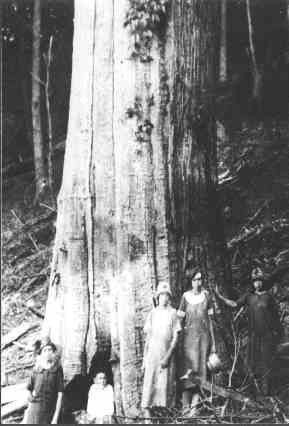
Courtesy Great Smoky Mountains National Park Library

The American Chestnut was king among trees in the eastern forests. At one time, it dominated the Appalachian mountains from Canada to Georgia and was estimated at a population numbering 4 billion or 25 percent of the eastern forest population. And it was BIG, growing up to 150 feet tall and 10 feet in diameter!

A critical commodity to the rural Appalachian economy, its wood was straight-grained, easily worked, lightweight and highly rot-resistant which made it prized for everything from lumber for home construction to furniture to split-rail fencing. Structures that date to the turn of the century were likely constructed of American Chestnut. The tree also produced nuts that were highly valuable and sought after by both people and wildlife.

However, an invasive species of fungus introduced from Asia brought a catastrophic blight to the American chestnut. First found in 1902 in New York's Bronx Zoo, the blight spread like wildfire throughout the east and within 40 years brought devastation the tree.

Specimens can still be found in the wild, but seldom greater than 20 feet tall and 6 inches in diameter. Two of the largest surviving American Chestnut trees are in Jackson County, Tennessee. One is the state champion and has a diameter of 61 cm (24 in) and a height of 23 meters (75 ft) and the other tree is nearly as large.

On May 18, 2006, a biologist with the Georgia Department of Natural Resources spotted a stand of several trees near Warm Springs, Georgia. One of the trees is approximately 20-30 years old and 13 meters (40 ft) tall and is the southernmost American Chestnut tree known to be flowering and producing nuts. Another large tree was found in Talladega National Forest, Alabama on June 2006. It is 26 meters (85 ft) tall with a diameter of 35 centimeters (14 in).

A combination of factors may account for the survival of these relatively large American Chestnut trees including low levels of blight resistance, hypovirulence (the attacking blight fungus is weakened by a virus), and good site conditions. In some cases, large chestnut trees have just been lucky and have not yet been exposed to the blight-causing spores.

Several organizations are working on restoring the American Chestnut to its historic eastern range.

The American Chestnut Foundation
Probably the most notable organization working on behalf of the American Chestnut. Based in Bennington, Vermont, ACF seeks to restore the American Chestnut by creating a blight-resistant American Chestnut by "backcrossing" blight resistance from the Chinese chestnut into the American Chestnut, while maintaining the American Chestnut’s characteristics. A blight-resistant American Chestnut tree is expected to be ready soon for forest test-planting and for wider distribution within the next decade. An American Chestnut from ACF's research farm in Meadowview, VA was planted on the White House lawn during last year's Arbor Day celebration.

American Chestnut Cooperators' Foundation
The American Chestnut Cooperators' Foundation's goal is to raise funds to support graduate and undergraduate student research projects at Virginia Tech's Department of Plant Pathology, Physiology & Weed Science, and at Concord College, West Virginia. The research makes possible seedling and nut distributions from an all-American breeding program to restore American Chestnuts to native forests.

The Canadian Chestnut Council
The Canadian Chestnut Council is a charitable organization that has been actively involved since 1988 in the development and implementation of numerous objectives in support of the American Chestnut. CCC acts as an information network for coordinating the support efforts by various Chestnut enthusiasts and research scientists across Ontario and Canada, and to communicate with similar groups in the United States and elsewhere.

Also noteworthy is an article on the American Chestnut in National Geographic Magazine.

Monday, August 14, 2006

Moving the Mountains

Roanoke Times reporter Tim Thornton has a series about what is happening in the coalfields of Southwest Virginia and Southern West Virginia called Moving the Mountains. Below is the most recent feature in the series, the rest can be found here.

Women make some noise about mining blasts
Two residents of a coal mining town are fighting for an ordinance that would limit explosions.

STEPHENS, VA -- The coal mine is quiet now. It has been since the company that ran it went bankrupt in May. But Kathy Selvage and Charlene Greene are pretty sure some other company will come along and pick up where that one left off.

They're convinced it's just a matter of time before another crew comes in to set off explosives and bring the beep and roar of heavy machinery back to their houses from early morning to early morning.

"If you opened the windows," Selvage recalled, "in rushed the noise and the dust."

So Selvage, 56, and Greene, 64, are trying to get the Wise County Board of Supervisors to pass a noise ordinance. Their proposal has been embraced as a new front in the struggle over mountaintop removal mining and other large strip mine operations in Southwest Virginia.

The ordinance wouldn't apply only to the mine that looms over Stephens, but it would certainly affect it. The old operation was supposed to run 20 hours a day, though Selvage and Greene say it routinely went longer. They want to limit mining in residential areas to 15 hours a day, from 7 a.m. to 10 p.m. during the week. On Sundays, the noise couldn't start until 10 a.m.

The ordinance would apply to other noisy things, too: stereos, leaf blowers, power tools. But it's the mining that's drawn attention.

"This is an issue that could be -- and has been in times past -- kind of volatile," Board of Supervisors Chairman Fred Luntsford said wryly. "I think everybody deserves to have a peaceful atmosphere around them. But we all know Wise County is a coal-producing county, and with that comes this type of thing.

"Those points will be argued seven ways to Sunday."

If the argument ever gets started.

Greene and Selvage took a draft ordinance to a board work session on the first Thursday in July and left believing their proposal would be on the agenda at the supervisors' regular meeting the next week. It wasn't.

"Frankly, there wasn't a lot of support among the supervisors to have it on the agenda," Luntsford said.

But he persuaded the board to put the issue on August's agenda, Luntsford said in July. Luntsford wasn't talking about discussing the ordinance. He's proposing having a discussion about whether the board should schedule a public hearing so there can be a discussion about the ordinance.

And even that may not happen. After some county officials said they didn't want to talk about a noise ordinance until they'd seen an enforceable county ordinance -- Selvage and Greene modeled their proposal after a town ordinance -- Selvage and Greene brought the supervisors a copy of Pulaski County's noise ordinance.

The supervisors liked that ordinance, but Selvage said Aug. 1 that Pulaski County's ordinance wouldn't accomplish what she and Greene want. In Pulaski, the big issue was a racetrack, Selvage said. That's entirely different from mining, she said. Some of the activists who are trying to end mountaintop removal mining have taken notice of Greene and Selvage's efforts, but the pair aren't professional campaigners. Far from it.

"We were just two housewives, is what we were," Greene said, sitting on Selvage's front porch. "We weren't interested in things like this -- were we, Kathy? -- until it was put right here in front of us."

"We started at ground level," Selvage agreed. "We didn't know anything."

Selvage's first complaint about the mine came late last summer, after a particularly violent explosion. She was accustomed to the blasts used to break up the layers of rock that cover coal seams, but this one was different.

"I actually thought for a few seconds there it was an earthquake," Selvage said.

She suspected that Glamorgan, the company running the mine, was using a bigger charge than the law allows. Selvage has lodged many complaints since then, she said. State mining regulators bring out equipment to measure the blasts. Only two or three times have the explosions been officially over the line, she said.

There's been no blasting since Glamorgan's parent company went bankrupt, and now the state Department of Mines, Minerals and Energy may revoke the company's permits at Stephens and three other sites because of apparent misstatements in company filings with the agency.

Greene began her campaign six or eight months before she teamed up with Selvage. Mining laws are just too lax, she said. Mining activity, including blasting, is allowed 300 feet from houses. Last year, a rock the size of a hard hat plunged into one house in Stephens.

Greene and Selvage say the bankrupt company had permits to mine 500 acres underneath Stephens, and that worries them more. "We don't want to go the way of Pardee," Selvage said. "Pardee doesn't have an inhabitant."

Named for the president of a coal company, Pardee was a Wise County coal camp. The only place you can see it these days is in "Coal Miner's Daughter." Pardee provided street scenes and a company store for the Loretta Lynn film biography.

"Right after they finished filming, they tore down the commissary," said Brian McKnight, a former teaching fellow at the University of Virginia's College at Wise.

The whole community is a mine site now.

Bill McCabe, a Sierra Club organizer, has helped Greene and Selvage in their campaign. Greene and Selvage have helped an anti-mountaintop-removal group that appeared in the coalfields last year, Mountain Justice Summer, make contacts in their community.

"I don't know if what we're looking at is mountaintop removal because they didn't just remove the top," Selvage said as she looked toward the silent mine. "They took the whole thing."

This pair of coalfield housewives is promoting renewable energy.

"I think Charlene and I would have been tickled to death to see windmills on top of that mountain instead of taking the whole thing down," Selvage said.

But for now, they'll concentrate on noise, asserting that residents' right to a few hours of quiet is worth as much as a company's right to dig coal.

"We would hope that other people in other parts of Virginia would come to understand what is happening to us," Selvage said.

Maybe if the blasting were going on 300 feet from the state Capitol, legislators would notice, she said. Maybe if a coal company executive had to live in a house at the edge of a mine for a month, something would change.

"I will spend whatever time I have on this earth," Greene said, "trying to bring regular people on the same level as coal."

Thursday, July 27, 2006

Mountain Top Removal (MTR) Mining

Courtesy www.appvoices.org
It's a topic that draws emotion beyond words from some folks, in others the emotion is buried down somewhere beneath the overburden and money. It is a disastrous practice which benefits a small number of corporations at the expense of local communities, the environment, and our mountain future. It is Mountain Top Removal mining and it is the gravest threat to Appalachia since the broad form deed.

Until recently, the fight against MTR has remained largely out of the mainstream media airwaves and thus out of the public eye. Several highly regarded publications and personalities including National Geographic, Vanity Fair, NOW with Bill Moyers, and NPR's Bob Edwards (whose compelling documentary "Exploding Heritage" airs this weekend on XM 133 and NPR!) have recently featured MTR. And there are several excellent websites by folks dedicated to increasing awareness about MTR and how we can hopefully one day stop it.

Links and descriptions are provided below:

  • Appalachian Voices A grassroots organization working with coalfield residents and legislators to end Mountaintop Removal. Lots of facts and resources for learning more about Mountaintop Removal

  • Kentuckians For The Commonwealth - a grassroots activist organization that fights against Mountaintop Removal mining.

  • Economic Impact of Mountaintop Removal on Coal-mining Communities -- an article by Kristin Johannsen

  • Moving Mountains Article in Orion magazine by Erik Reece.
  • Death of a Mountain -- A gut-wrenching account of MTR by Erik Reece

  • Mountain Justice Summer Campaign

  • Ohio Valley Environmental Coalition

  • Mountaintop Removal Clearinghouse A blog attempting to bring together the many resources and people working on issues related to mountaintop removal (MTR) coal mining in Appalachia.

  • Missing Mountains: We Went to the Mountaintop But it Wasn't There -- 35 Kentucky writers explore mountaintop removal mining.

  • Bringing Down the Mountains: the Impact of Mountaintop Removal Surface Coal Mining on Southern West Virginia Communities, 1970-2004 A Ph.D. dissertation that is the first historical treatment of mountaintop removal coal mining and its various effects on southern West Virginia communities by West Virginia University alumnus Dr. Shirley Stewart Burns.


  • Photographs and Images of MTR:

  • Satellite photographs of Mountaintop Removal sites in Kentucky

  • West Virginia photo gallery

  • Mountaintop Removal Photo Gallery


  • Some government links on MTR:

  • Mountaintop Mining & Valley Fills in Appalachia: Final Programmatic Environmental Impact Statement (Final PEIS)

  • US Government Office of Surface Mining page on mountaintop removal


  • And the nasty curmudgeons who practice, advocate for, and promote MTR:

  • Massey Energy Company

  • International Coal Group-The corporation responsible for the Sago disaster

  • Peabody Energy

  • Arch Coal, Inc

  • Friends of Coal - Political Action Committee and advocacy group that defends the positions of the coal mining industry and argues for less government regulation; the site has no page specifically dealing with mountaintop removal

  • Kentucky Coal Education This pro-coal website contains "Fun Stuff" for kids as well as lesson plans and other resources for teachers and the public.

  • West Virginia Coal Association West Virginia's pro-business, pro-coal site. The site contains many statistics on production and employment.
  •