Showing posts with label history of appalachia. Show all posts

Wednesday, September 12, 2007

A school for subversives and Communists?

How would you like to have attended the same school that Rosa Parks, Eleanor Roosevelt, Pete Seeger, Woody Guthrie, Martin Luther King Jr., Andrew Young, and Fanny Lou Hamer all attended?

That would be Highlander Folk School, near Monteagle, TN, for many years the only place in the South where white and African-American adults could live and work together, something that was illegal in that strictly segregated society. The 1950s brought Highlander to national attention, as civil rights legends and social activists learned the ways of non-violent protest there in the school’s “Citizenship School Program.” Rosa Parks’ participation in a Highlander workshop in the summer of 1955, 5 months before her back of the bus incident, had a crucial influence on her. And during the subsequent Montgomery bus boycott, Highlander co-founder Myles Falls Horton introduced Rosa Parks to Eleanor Roosevelt as “the first lady of the South.”
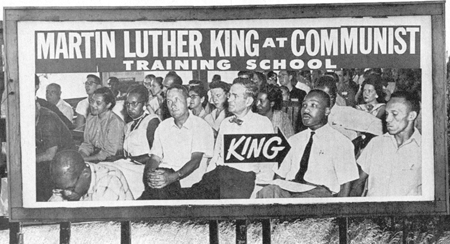
billboard denouncing Highlander Folk SchoolPolitical enemies angrily erected billboards across the South showing Martin Luther King and Rosa Parks attending an integrated event at the Highlander Folk School in 1957.

But two decades earlier when the school was first begun, poor, uneducated miners learned about self-respect and self-empowerment at the school. In his autobiography, Horton wrote, "We didn't think of ourselves as working-class, or poor, we just thought of ourselves as being conventional people who didn't have any money."

Highlander, Horton once claimed, held the record for sustained civil disobedience, breaking the Tennessee Jim Crow laws every day for over forty years, until the segregation laws were finally repealed.

Horton attended Cumberland College in Tennessee, Union Theological Seminary in New York City, and studied Danish folk school models on site before opening the Southern Mountains School, in 1932. A short time later, he and co-director Don West, a Congregational minister from Georgia, changed the name to the Highlander Folk School. At Highlander the purpose of education was to make people more powerful, and more capable in their work and their lives. Horton had what he called a "two-eye" approach to teaching: with one eye he tried to look at people as they were, while with the other he looked at what they might become.

Not everyone was tickled by the Highlander formula. One anonymous Tennessee citizen wrote FBI director J. Edgar Hoover in 1936: “This school is a hot-bed of communism and anarchy. This is proven by the part taken by its members in the strikes at Harriman Tenn., Daisy Tenn. and at the present at Rockwood Tenn.” Hoover promptly opened a file, one that over the years accumulated in excess of 1,000 pages.

For his outspoken support of union, civil rights, and poor people's organizations, Horton endured arrests, threats, violence, and denunciations from industrialists, politicians, and segregationists.

Finally, in 1961, the state of Tennessee closed the school, revoked its charter, and sold off the assets at auction. During this time, many of the buildings were burned by arsonists. Undaunted, Myles Horton redesignated the folk school as a research center under a new charter and moved from Monteagle to Knoxville, and then to the present location in New Market, Tenn., where it is now known as the Highlander Research and Education Center.


sources:www.etsu.edu/cass/archives/Collections/afindaid/a598.html
http://education.stateuniversity.com/pages/2072/Horton-Myles-1905-1990.html
http://tennesseeencyclopedia.net/imagegallery.php?EntryID=H073

Related posts: "Don West background"

Originally blogged at: Appalachian History


, , , , , , , , ,

Friday, August 17, 2007

Somebody ought to give the true picture of them

“So many outside writers had come in and . . . and given such a terrible account of the people. They had put 'em down a lot in their articles that I didn't think this was true, because the people that I met were very intelligent and they were very civilized. They were not like they were pictured in these articles at all. And I thought that somebody ought to come through here and give the true picture of them.

Life magazine article on Frontier Nursing Service Left: 1937 LIFE magazine article profiling Mary Breckinridge's Frontier Nursing Service, for which Mary Brewer worked at the time.

"And, you know, the Mary Breckinridge . . . the hospital. Mary Breckinridge, of course, was the first one, I guess, that put the people in this area on the map by going out and soliciting aid, and naturally most of their material was slanted toward the poorer class of people. They didn't tell anything about the fine homes that were here. It was always the little shacks on the hillsides and people going without clothing and half-starved and barefoot. So that most people in . . . outside of Kentucky, they got the wrong idea, and I . . . I thought that ought to be corrected.

“Well, in 1958, the . . . Berea College had asked me to do some research for the Ford Foundation. And I started out in the field, traveling with Rufus Fugate and Ruth Baker, who was a home agent at that time, and I began to find all these old people that had these interesting stories to tell me and I began writing them down. And it just grew and grew from that until I got a good collection and I thought well, it ought to be shared with others and I decided then to have it published. And Vernon Baker came to see me then. He knew that I had this material and said he was interested in publishing it. And he published it under the title Of Bolder Men, but it fell apart. It was just a disaster. [Chuckle]

“So I quit selling the book because it did fall apart. It wouldn't stay together. And then I decided there were so many requests for it that I would write it over again. And they decided to use it as a part of the centennial celebrations for Leslie County then. So I did it over for that purpose mostly, that it might be used for that. [A large part of it is sort of a genealogy] of people who live in Leslie County. I got the history from Leslie County by going to the courthouse and talking to old people who were here, you know, and knew the history of it. The first part of it is involved with the history and development of Leslie County itself, and . . . and the second part of it contains the genealogical history of about forty families.”

Originally blogged at Appalachian History

1978 interview with Mary Brewer,
author of "The Rugged Trails of Appalachia"
Oral History Project, Frontier Nursing Service, Kentucky Virtual Library
http://tinyurl.com/3axr6o

Friday, August 03, 2007

That old-time tent revival

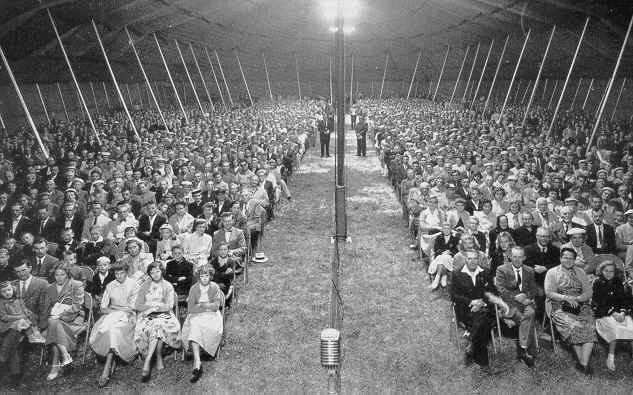
It’s tent revival season throughout Appalachia! Last week the Voice of the Word Ministries tent revival took place in Johnson City, TN. This week the Blue Ridge Foothills annual tent revival kicks off in Wolftown, VA. You can bet there are hundreds more throughout the region – the region that invented the tent revival.

The first camp meeting took place in July 1800 at Gasper River Church in southwestern Kentucky. A much larger one was held at Cane Ridge, Kentucky, in August 1801, where between 10,000 and 25,000 people attended, and Presbyterian, Baptist and Methodist ministers participated. It was this event that stamped the organized revival as the major mode of church expansion for denominations such as the Methodists and Baptists, who were newly converted by the teachings of John Wesley.

“The significant and most recurring theme in mountain preaching,” according to Deborah McCauley, author of Appalachian Mountain Religion, “is that of a broken heart, tenderness of heart, a heart not hardened to the Spirit and the Word of God. Mountain people teach through their churches that the image of God in each person lives in the heart, that the Word of God lodges itself in the heart, and the heart is meant to guide the head, not the other way around.”

Elkridge WV Tent Revival 1930s
“God led me into the Free Methodist Church when in 1935 I was sanctified in a revival preached by Brother Albert Faust from Pittsburgh,” said West Virginian Dewilla Lemmon of her revival experiences. “Melrose Uphold, a neighbor, and Sister Eva Young, a local Free Methodist preacher, arranged for a meeting in a vacant building near my home. This came as an answer to prayer for me because I had been privately seeking holiness, not really knowing what it was, only that for many months I had craved a pure, perfect condition of heart with God, notwithstanding the knowledge that I had been born again.”

One of Lemmon’s fellow worshipers, “Sister Uphold,” explained to her that the experience she sought was “sanctification.” “So I went to the altar and prayed for it. I also made various restitutions. Brother Faust quoted the Scripture: ‘The Lord whom ye seek, shall suddenly come to his temple.’ And Jesus did just that for me on the night of September 22, 1935 after Brother Faust had delivered his sermon and while Sister Young walked up and down behind me at the altar quoting in a strong voice: ‘This is the will of God, even your sanctification.’”

Sources: http://are.as.wvu.edu/ferber.htm#_edn24
Lemmon, Dewilla. “Camp Memories” journal exercise recorded by Pauline Shahan. July 6, 1980
Appalachian Mountain Religion. University of Illinois Press: Chicago; 1995
http://www.theopedia.com/Great_awakenings

Related Posts: "Warmly Tactile Worship Behavior"

Originally blogged at "Appalachian History"


Friday, July 27, 2007

If I couldn't talk I'd bust

"Yes, I am working on a part time job as cook, but you don't need to ask what I'm doing the rest of the time. What don't I do? I get up early and sometimes wash out clothes or clean house. You'd be surprised at the dirt these roomers bring in; they never think of wiping their feet on the mat. My mammy gets dinner ready for the girls when they come home from the mill, but she won't wash up the dishes. She leaves them for me to wash when I come home. And then the family expect me to get supper. Sometimes I find my mammy and my youngest sister--they always sleep together and are just like twins--layin' on the bed waitin' for me to git 'em somethin' to eat. After supper me and another sister go out and work the garden until dark. So you see I don't have time to git lonesome.
photo by Doris Ulmann
"I hardly get time to go to church either. My family was Lutherans in the old days, but there ain't no Lutheran church here and we are all mixed up; we go to different churches--when we go at all. One of my sisters bought a good second-hand auto and we sometimes spend Sunday visiting our relations in the country. They always have plenty to eat, and I like a change of vittles sometimes. And it's good for sore eyes to see somebody else wash the dishes.

"One church we don't go to is the one down there by the mill. They have lively times down there, they tell me. When I go to church, I want it to be like a real church, and when I go to the movies I want somethin' else. I'd go to church oftener if I had the right kind of clothes; but when I have a nice dress I may not have a good hat or decent shoes, and when I have a good hat and shoes maybe I haven't a nice dress. I don't care very much about clothes, but I like to look as decent as anybody else. So I go to church when I feel like it and when I have respectable clothes; and it's nobody's business but my own."

Miss Ophelia Mull
Brevard, N.C.
Interviewed June 26, 1939
American Life Histories: Manuscripts from the Federal Writers' Project, 1936-1940
http://tinyurl.com/2hvvlk


Originally blogged at Appalachian History


Wednesday, July 18, 2007

Lived alone, suffered alone, died alone

July 22 will mark the 84th anniversary of Nick Grindstaff’s demise. His gravestone reads: “Lived alone, suffered alone, died alone,” but in the 1870’s he was one of Johnson County, TN’s most colorful residents. Grindstaff was born on December 26, 1851. By the time he was three years old both his mother, Mary Heaton Grindstaff, and his father, Isaac Grindstaff, had died. Nick and his three orphaned siblings lived with relatives until Nick was 21 years old, at which time the parents’ farm was divided equally among the children. Nick built a house on his portion and began to farm the land. After five years of farming Nick sold his farm and decided to go west.

He was an adventurer, and like so many young men of that era, smelled his fortune in California gold. While there he met, fell in love with, and married a young woman. The woman died.

Lake Watauga, TNOn his way back to Johnson County, legend says Grindstaff was coaxed into the rear of a saloon by a “lovely lady,” whose partner in crime robbed him of his fortune. In another version of this story, he was not robbed, but drank all his money away when his wife out west died; when he became destitute he moved back to Johnson County. In either case, he returned to Tennessee and bought land on top of Iron Mountain, were he lived for 40 years as a hermit with only his dog Panter, a steer and a pet rattlesnake (said to have been killed by a man named Sam Lowe) for company.

On July 21, 1923 Baxter McEwen went by to check on Nick. He found him dead on the bunk in his hut. His faithful dog had been keeping watch over his master's dead body for the previous three or four days. The dog had to be tied before men could carry out Nick's body. Nick was buried, with 200 in attendance, on the mountain peak where he had lived. The house was eventually dismantled for the wood and tin, but the imprint is still on the ground surrounding the gravesite.

Two years later locals erected a chimney-shaped monument made out of mountain granite, which even included some of Nick’s pots and pans in the construction. The citizen who kept the general store down in Shady Valley, Tennessee, where Grindstaff would buy his meal and bacon twice a year, wrote the words. Somebody had to. Nick Grindstaff was a special man, with a story no one ever quite knew.

Today the Appalachian Trail passes by the area. The Appalachian Trail Conference maintains the monument that marks Nick's burial site.

sources: http://www.mce.k12tn.net/johnson/legends/nick.htm
http://johnsoncountychamber.org/JCChamber/chamber/Docs/NewsletterOct.pdf

Originally blogged at Appalachian History


Wednesday, July 11, 2007

Tossing the caber

If you missed the Gatlinburg (TN) Scottish Festival & Games back in May, or can’t wait till November for the Scottish Clans of the South to gather in Hendersonville, NC, don’t panic. The Grandfather Mountain Highland Games in Linville, NC is the largest assembly of Scottish clan society members in the world, and it’s coming up July 12-15.

Scottish-Americans, Scotch-Irish Americans, Scots and would-be Scots converge each year on two rock-strewn pastures, known as MacRae Meadows, in the shadow of the tallest peak in the Blue Ridge chain, the 5,964-ft. Grandfather Mountain.
http://www.lochhartwell.org/index.html
Dancing, running, throwing large poles and bragging about one's Scottish ancestry-it's all part of a day's work at highland games.

The centuries old Scottish tradition of staging competitions at cattle fairs continued when Scottish immigrants came to North Carolina in the 18th century. The newcomers felt at home in the North Carolina mountains, and descendants of these pioneers continued to speak Gaelic into the early 20th century.

Scottish heavy athletics events include Clachneart (16 lb. stone throw), 22 lb. hammer throw, 28 & 56 lb weight throw, 56 lb toss for height, caber toss, tossing the sheaf (16 lb.) and Highland wrestling.

The caber toss is a contest in which brawny men flip 21-foot (6.4-meter) wooden poles weighing hundreds of pounds end over end. If you imagine that the brawny man is standing in the center of a clock face looking toward the number 12, the objective of the caber toss is to make the pole land so that it's pointing exactly at high noon.

Putting the pole squarely on the imaginary 12 is extremely difficult, however. Sometimes years pass before a contestant nails a caber toss with a perfect landing. More likely, a contestant who can get his caber to point to 11 or 1 on the imaginary clock will win. The first recorded caber toss competition was in 1574.

http://lcweb2.loc.gov/cocoon/legacies/NC/200002907.html
http://news.nationalgeographic.com/news/2005/07/0707_050707_highlandgames_2.html

Originally blogged at Appalachian History


Wednesday, July 04, 2007

You scream, I scream, we all scream for...

Get the ice cream maker out! It’s summer, and there’s nothing so fine as freshly made rock salt ice cream. Just make sure you gather every kid in the neighborhood to take a turn cranking the dang thing.

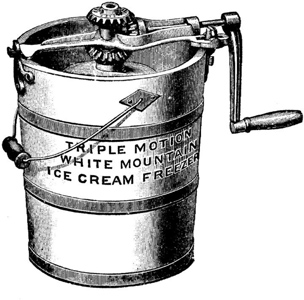
White Mountain Ice Cream FreezerIn 1843 Nancy Johnson developed the first hand-crank ice cream maker (her basic design of the freezer is still used today), and received Patent No. 3254 for it. Much of the confusion (and lack of credit) to Ms. Johnson comes from the fact that she sold her rights to William Young for just $200 (still a pretty good sum in those days.) He at least had the courtesy to call the machine the “Johnson Patent Ice-Cream Freezer.”

Johnson’s invention simplified the process of making ice cream, marking a revolution in the history of the dessert. From this time on, anyone could make the very best quality ice cream at home (especially since rock salt, which came to be commonly called "ice cream salt" until the early 20th century, had became a cheap commodity).

The inner can was placed in the outer bucket, and ice and salt were placed between the inner can and outer bucket. The salt lowered the freezing point of the ice, and contact with the inner bucket made a thin layer of milk freeze on the inside of the inner can. The rotating paddle, turned by a crank, scraped off the frozen milk, and let a new layer freeze.

Meantime, by 1919 the ice cream industry was churning out (NOT by hand!) 150 million gallons a year, so if you really didn’t want to wait the time it took to hand-crank your own, you could probably scoot down to the general store for a cup or a cone.

However you take your ice cream, can Ice Cream Socials be far away?

Sources: http://www.zingersicecream.com/history.htm
http://whatscookingamerica.net/History/IceCream/IceCreamHistory.htm


Originally blogged at Appalachian History


Thursday, June 21, 2007

The shack out back

Tennesseans called it the “la-la.” Elsewhere known as the john, the shanty, the shack, the throne, the shed, the relief office—it was the humble outhouse. The little buildings "out back" were as important as any building built before indoor plumbing. This was the building you located as soon as possible when you came to visit, and if your guest was the preacher, you invited him outside on some pretext so he could spot "the necessary room" without asking.

During the 1930s the WPA built thousands of outhouses across America. Three-man teams would spend an average of twenty hours on the construction of each one. Where possible the farm family receiving the new outhouse would pay for the materials (about $17 per outhouse), while the WPA supplied the labor free.

These were outhouses like America had never seen before. The American Red Cross developed the basic design. This design featured an enclosed, vented pit for the waste, was fly and vermin proof, and afforded a standard of cleanliness and sanitation that earlier generations would have considered effete.

http://www.sewerhistory.org/images/pr/pro/pro14.jpgThe building had a concrete floor and a carefully carpentered seat with a close fitting lid to exclude flies. Although many design variations existed, the two basic designs were single seater and two seater.

The two seater was preferred by large families---the second seat had a smaller hole to prevent children from falling through---by those who liked company, and by those who needed a place to set their lantern at night.

“To the right of the narrow entrance was a complete collection of fishing equipment ranging from rods and reels to every size, shape and color of lure imaginable. Directly above these hung an array of ingenious traps which proved to be the scourge of every muskrat and mink for five miles up or down river. In the rear of the little edifice stood two tall bushel baskets containing an endless conglomeration of treasures ranging from outdated articles of clothing to ancient magazines.

“The latter provided amusement and literary driblets for the perusal of the lackadaisical visitor who wished to bide his time informatively. And we must not overlook that standard piece of equipment without which the outhouse would not have been an outhouse--that savior of the toilet-paper-destitute family--the good old catalog. Where would we have been without it? Why do you think the mail-order house was such a thriving success?”

Robert E. Dalton
born Robert E. Lee Dalton, 1938,
in Itman, Wyoming County, WV

And those crescent moon cutouts on the door? That goes back to Colonial times. In a time when few people could read, the crescent moon was the symbol for women while the star cutout was for men.

Sources: http://jldr.com/ohillbil.html
http://www.cresswellslist.com/ballots2/wpa_outh.htm
http://www.rootsweb.com/~hcpd/norman/OUTHOUSE


Originally blogged at Appalachian History

Thursday, June 14, 2007

Did the early polio vaccine cause cancer??

In October 1960, Dr. Bernice Eddy gave a talk to the Cancer Society in New York without warning her employer, the National Institutes of Health, in advance. She startled the attendees by announcing that she had examined cells from monkey’s kidneys in which the polio virus to be used in polio vaccines was grown, and had found they were infected with cancer causing viruses. Dr. Bernice Eddy

She had decided on her own initiative to test extracts by innoculating newborn hamsters, since these animals developed tumors with a type of virus she and Dr. Sarah Stewart had previously discovered in mice and named polyoma virus (one of the early known cancer-causing viruses, it was later named the SE (Stewart-Eddy) Polyoma Virus in their honor.)

The inoculated hamsters developed tumors similar to those induced with polyoma virus. Her inference was clear: There were cancer-causing monkey viruses in the polio vaccine. She warned an epidemic of cancer in America was in the making. When the word got back to her NIH bosses, they exploded in anger.

Polio vaccineWhen the cussing stopped, her superiors crushed Bernice Eddy career wise. Any mention of cancer causing monkey viruses in the polio vaccine was not welcomed by NIH. They took away her lab, destroyed her animals, put her under a gag order, prevented her from attending professional meetings, and delayed publication of her scientific paper. In the words of Edward Shorter, author of The Health Century, ‘Her treatment became a scandal within the scientific community.’

Later, it became the subject of a congressional inquiry. In the words of Dr. Lawrence Kilham, a fellow NIH researcher who wrote a latter of protest to the Surgeon General’s office, ‘the presence of a cancer virus in the polio virus vaccine is the matter demanding full investigation.’ Her discovery was in fact subsequently validated by Drs. Maurice Hilliman and Benjamin Sweet of Merck. After additional studies, the vaccine was found to not cause tumors in humans, but Dr. Eddy was still restricted by the government from publishing anything about her work.

The work of Dr. Eddy and others led to safe polio vaccines through thorough testing, and provided a major impetus for further research on cancer viruses. The United States Department of Health, Education and Welfare awarded her a Superior Service Medal in 1967.

Bernice Eddy Wooley, Ph.D
(1903-1989)
born Glendale, WV


originally blogged at Appalachian History


http://epics.ecn.purdue.edu/abiwt/work/GAW/westvirginia.html
http://www.sv40foundation.org/
http://www.vaccinetruth.org/page_13.htm

Wednesday, June 06, 2007

Language with gumption

When you’re talking with family, are you liable to let down your guard a little and use a bit more Appalachian English and a bit less Standard American English?

For example, the Standard American English word might be faucet, but the Appalachian English version would be spigot. If somebody looks sick, we might say, "he's peaked" (that's peek-ed). Did you hurt your finger? Then we might say you "stoved it up." Some people say "knowed" rather than "knew." We're famous for our double negatives. "I don't have none of that." Our present perfect tense has raised some eyebrows, too. "He's done done it now!" While we’re at it, here’s a little mini-dictionary to amuse the lexicographers:

A little past plumb-----not right in the head
Atter wile-----------------after a while
Back door trots-------------diarreah
Beer Eats-----fastfood joint
Buss-----kiss
Can't put an old head on young shoulders--intelligence differences
Cassins-----tires
Dead dog tired--------- weary
Don't swing so big----don't swing so high
Dreckly-----directly, in a short while
Fast as greased lightning------------speedy
Fixing to-----getting ready to
Full of spunk------------ spirited
Gittin too big for his britches-----conceited
Gommin' up the table------making a mess
Gumption-- drive or spirit
Herrit-----hello
Jerk a knot in your tail-----parent to unruly kid
Juberous----- leery
Made the riffle------ completed a business deal
Nary a one----don't have any at all
Ninny----short for nincompoop
Nussing----- nursing
Peep-Eye-----same as peek-a-boo
Pime blank---exactly
Play purties-----toys
Poor as Job's turkey----------without funds
Reach me that-----give me that
Rue-----regret
Shirky--------doing a job poorly
Shite poke-----skinny, sickly looking
Slop jar-----a chamber pot
Sober as a judge-------sobriety
Spoondiken------also known as 'courting'
This milk's blinky-------spoiled milk
Three sheets in the wind----------intoxicated
Too slow to stop quick---------- pokey
Vittles-----food
Weed monkey----a loose woman
With-----tree branch, used for punishment
Woods colt-----child born out of wedlock

Originally blogged at Appalachian History


Wednesday, May 30, 2007

America’s most famous soldier comes under fire


When Sergeant Alvin C. York returned to America in 1919 as the best-known hero of the World War, he decided to devote his attention to improving education in his native rural Tennessee. But by 1933 the state Department of Education was investigating charges that York was guilty of incompetence, negligence, nepotism, and bringing in outsiders. What happened?

York's tenure in the military overseas made him painfully aware of his own educational shortcomings and convinced him that an adequate education was the key to advancement. He originally wanted to create several small schools strategically placed in the mountains, but found the goal to be unrealistic. He decided instead to put his energy towards creating an institution known as the York Industrial Institute (later changed to the York Agricultural and Industrial Institute).

In 1925 the Tennessee General Assembly appropriated fifty thousand dollars toward the school's construction. York announced in 1927 that any future donations or gifts that would have gone to him would now go to the building of schools. He helped further finance the project by going on lectures. However, debt piled up, and when his health began to fail, his financial picture only worsened. He had raised only about $10,000 in a school fund. York, a Democrat, battled the local Republican Fentress County executives over the school's location. Local officials threatened the school’s eviction from the site, and York appealed directly to the state legislature and national media for support. As a result, the 1925 legislation was amended to give the state Department of Education oversight of York Institute.

The school finally opened in 1929, but even with state backing York's problems continued. County officials refused to support the school. In order to pay teachers' salaries, York twice mortgaged his home and paid the teachers directly from his own pocket. He also bought school buses with his own money because the county refused to provide them.

The 1933 investigation uncovered no corruption, but state officials recognized that York was ill equipped to assess the capabilities of faculty. And so, the Department of Education decided in 1937 that for the survival of the institution, the state would administer the school's operation. York was named president emeritus and presided over ceremonial functions.

More than twenty years after he returned home from France, Sergeant Alvin York signed with Warner Brothers to tell his life's story. He acted as advisor. Gary Cooper played York, for which performance he won an Academy Award. The movie was released in 1941.

With the $169,449.84 he received from Warner Brothers, York was able to pay off most of his debts.

Sources:
http://tinyurl.com/2whl2e
http://tinyurl.com/328twe


Originally blogged at Appalachian History


Monday, May 21, 2007

17,400 pounds of string

http://www.citypaper.com/sb/48852/900.jpg
Masking tape was invented in 1925, cellophane tape in 1930, and duct tape in 1940. What on earth did people use before these wonderful adhesives? Why, string or twine, of course. And chances are that the first two inventions were new enough in the culture during the 1930s that plenty of people, out of old habit, still relied on tying things rather than taping them. And furthermore, because of their newness, tapes were pricier than string.

You’re a thrifty farmer, it’s the Depression, and that new fangled tape, though appealing, is expensive. You might simply purchase store-bought string. Better yet budget-wise, you could pull odds & ends of string from say, butcher’s packages, or the morning newspaper ties, and create yourself a Big Ball of String to tap as needed.

So it comes as no surprise that a farmer would be the one to take this originally very sensible idea to its extreme conclusion, and create not just A big ball of string, but the BIGGEST ball of string! 17,400 lbs. and 12 feet in diameter, and twine, to be exact. Nor does it come as a surprise that the farmer, Francis A. Johnson, of Darwin, MN, was born in 1904. In other words he was of a generation used to using string or twine, not tape, to bundle things.

No, Johnson never lived anywhere in Appalachia, but you can bet there were and are plenty of farmers just like him throughout the region who’ve got their more humble, if perhaps a bit more useful, version of the big ball of string.

Orginially blogged at Appalachian History


Monday, May 14, 2007

The New Deal -- social elixir or socialist plot?


“I pledge you, I pledge myself, to a new deal for the American people,” said newly nominated Democratic presidential candidate Franklin D. Roosevelt on July 2, 1932.

Editorial cartoonists had a field day with the alphabet-soup of agencies the newly elected Roosevelt spun out starting in 1933: the AAA, CAA, CCC, CWA, FAP, FCA, FMP and so on: 15 in his first year in office alone!

More than one agency held out promise to Appalachian residents. The TVA (Tennessee Valley Authority) was an unusual entrance of government into business -- a government-owned network of dams and hydroelectric plants to control floods and produce electric power in the Tennessee Valley. The AAA (Agricultural Adjustment Administration) was an attempt to organize agriculture, though it favored the larger farmers as the NRA favored big business.

“The New Deal is plainly an attempt to achieve a working socialism and avert a social collapse in America; it is extraordinarily parallel to the successive 'policies' and 'plans' of the Russian experiment. Americans shirk the word 'socialism', but what else can one call it?” noted British author H.G. Wells.

It did give jobs to the unemployed, helped the consumer with lower electric rates, and in some respect deserved the accusation that it was "socialistic." But the New Deal's organization of the economy was aimed mainly at stabilizing the economy, and secondly at giving only enough help to the lower classes to keep them from turning a rebellion into a real revolution.

That rebellion was fermenting when Roosevelt took office:. Desperate people were not waiting for the government to help them; they were helping themselves, acting directly. Aunt Molly Jackson, a woman who very soon became active in labor struggles in Appalachia, recalled how she walked into the local store, asked for a 24-pound sack of flour, gave it to her little boy to take it outside, then filled a sack of sugar and said to the storekeeper, "Well, I'll see you in ninety days. I have to feed some children . . . I'll pay you, don't worry."

And when he objected, she pulled out her pistol (which, as a midwife traveling alone through the hills, she had a permit to carry) and said: "Martin, if you try to take this grub away from me, God knows that if they electrocute me for it tomorrow, I'll shoot you six times in a minute." Then, as she recalls, "I walked out, I got home, and these seven children was so hungry that they was a-grabbin the raw dough off-a their mother's hands and crammin it into their mouths and swallowing it whole."

source: http://www.ditext.com/zinn/zinn15.html


Originally blogged at Appalachian History


Saturday, May 05, 2007

Do you remember Grandma's lye soap?

“Hog killing was a value for rendering out your lard and make your cracklings and we use the scraps to make soap out of. The way we made lye was everybody had an ash hopper. It’s a big square box and you put all your ashes in it that you take out of the fireplace.

“You put it where you tilt it just so water runs in and drips out at one side and it makes lye. We use lye to render the husks from hominy and also to make lye with. And when the men folks decide to tan a hide, to make leather, the lye was used to remove the hair and everything off of it.

“Lye was a very important thing. You’d use tallow to waterproof stuff with. You’d do your washing on a washboard with lye soap. I can remember Octagon soap and powered soaps…they were the first ones I could remember.”

Hazel Farmer
Union County, GA Interviewed by Martha Clement June 2005 http://www.rootsweb.com/~gaunion/farmer.htm

http://www.rootsweb.com/~txcoryel/SOAP.jpg

"Grandma's Lye Soap"
John Standley and Art Thorson, 1952

Do you remember grandma's lye soap
Good for everything in the home
And the secret was in the scrubbing
It wouldn't suds and couldn't foam

Then let us all sing right out of grandma's
Of grandma's lye soap
Used for, for everything
Everything on the place
For pots and kettles
The dirty dishes
And for your hands and for your face

Shall we now sing the second verse
Let's get it with great exuberance, let's live it up
It's not raining inside tonight
Everyone, let's have a happy time
Are we ready
All together, the second verse

Little Herman and brother Thurman
Had an aversion to washing their ears
Grandma scrubbed them with the lye soap
And they haven't heard a word in years

Then let us all sing right out of grandma's
Of grandma's lye soap
Sing all out, all over the place
The pots and kettles, the dirty dishes
And also hands and also f.....
(clapping fades)

Well, let's sing what's left of the last verse
Let's have a happy time, everyone
The last verse, al-l-l-l together
Ev-v-v-very one

Mm-m-m-m, thank you kindly, kindly
M-m-mrs, O'Malley, out in the valley
Suffered from ulcers, I understand
She swallowed a cake of grandma's lye soap
Has the cleanest ulcers in the land

Then let us all sing right out of grandma's
Of grandma's lye soap
Sing right out, all over the place
The pots and, the pots and pans, oh dirty dishes
And the hands.


Originally blogged at Appalachian History


Friday, April 27, 2007

We all have pictures, we immigrants

http://bushlibrary.tamu.edu/pastexhibits/womenofourtime/Buck.jpg
"I had lived all my life an American away from America. Then I returned, a sort of immigrant among immigrants, except that I came to my native land. But it was as new to me as though I came from Sweden or from Italy or Greece. I knew almost as little what to expect before I landed.

"But we all have pictures, we immigrants, of what the America is to which we come. They must be pleasant pictures, or we would not have come. People do not easily leave all they know unless they hope for something much better. Now I had my picture of America, too. It was made up of visual images of my mother's much loved country home, of which she told me many stories, of a land of great plenty and ease, from which came money for the poor Chinese, because all Americans were rich and Christian.

"It would not have occurred to me that there were illiterate Americans, or unwashed or poor Americans, or criminals. As I grew older and understood better inevitable human nature this picture was modified and reason did indeed compel me to understand that heaven existed nowhere.

"But still something of this early picture persisted. Believed, for instance, that in leaving China I was leaving forever the sight of hungry people whom I was powerless to feed. I thought I was leaving behind the sight of wasting floods and dried and sun-baked, treeless lands, swept by dusty winds. I thought I was coming to a country which had organized itself into economic plenty and moral clarity. I had heard all my life that America was rich, and I did not think of these riches as being selfishly gained or used.

"Money was poured generously out of America into China for famine relief, for Christian propaganda, for many and endless causes. Americans, then, though they were rich were generous, interested in a world culture, international-minded. I longed to meet my countrymen, whose idealism seemed almost fantastic to the materialistic philosophy of China."

On Discovering America
Pearl S. Buck
June 1937
Nobel-prize winning author
born Hillsboro, WV


source: http://tinyurl.com/2bevth


Originally blogged at Appalachian History

Friday, April 20, 2007

The Grandfather of Bluegrass

That would be Wade Mainer, not Bill Monroe. A popular recording and radio personality, Mainer influenced generations of great musicians, including Bill Monroe, Ralph Stanley and Doc Watson. With his singing and banjo style, Wade and his band created a distinct sound that bridged the gap between old-time mountain music and bluegrass. Among his innovations was a distinctive two-finger banjo picking style crossing the traditional clawhammer with the modern three-finger picking style used by performers such as Earl Scruggs.
http://www.unctv.org/folkways/wade_mainer/
Born April 21, 1907, Mainer grew up on a tiny mountain farm near Weaverville, North Carolina. Old mountain songs were part and parcel of his upbringing and he was greatly influenced by the fiddling of Roscoe Banks, his brother-in-law.

“I was raised in the mountains back then and didn’t go out too much…but what there were of musicians, I would pay attention to them,” says Mainer. “I was interested in the sound of the banjo and when they’d lay there banjos down at the square dance…I’d go over and pick it up and play.”

As a young man, he moved to Concord to work in a cotton mill. Later he joined his brother J.E.'s Mainer Mountaineers, and began performing on radio in 1934. North Carolina was a hotbed of early country musicians during the Depression, and Wade Mainer stood out above the rest. The decade was a great time for brother acts, mostly duets, and mostly featuring close harmony singing with guitars or guitar and mandolin. These duos tended to supplant the larger string bands from the 1920s – traveling was easier, and there were less ways that gig money had to be split up during those hard depression days.

Along with his popular recordings Wade and his brother J.E. reached a wide audience with live radio programs sponsored by a patent medicine laxative called “Crazy Water Crystals.” Wade performed at Radio Stations WBT in Charlotte; WPTF in Raleigh; WNOX in Knoxville; and WPAQ in Mount Airy, among others. The sponsor kept him working but was notoriously stingy with pay causing Wade to part ways with both the sponsor and the Mainer Mountaineers in 1936.

http://www.countysales.com/cgi-upload/ecomm4/ecomm4_product/ccc360a806_OH4032CDbg.jpg<br />“I didn’t think they was paying me enough at $5 per week…I left them and got me a job at the yarn mill at $12 to $15 per week…and that was gold back then!”
Mainer and fellow bandmate Zeke Morris decided to work as a duet. They split up when Morris' younger brother Wiley joined to form the Morris Brothers. Mainer's new band was named the Sons of the Mountaineers; its first members included guitarists Jay Hugh Hall and Clyde Moody and fiddler Steve Ledford. They performed on the radio and also recorded many songs for Bluebird. In 1939, they had a good-sized hit with "Sparkling Blue Eyes."

Wade married singer/guitarist Julia Brown in 1937. Known as "Hillbilly Lilly," Julia performed from 1935-37 at WSJS RADIO in Winston–Salem, NC. A pioneering female vocalist, Julia would later join her husband for performances on the road.

Sources:
http://www.talentondisplay.com/kicprofiles04.html
http://www.unctv.org/folkways/wade_mainer/index.html
http://www.silcom.com/~peterf/ideas/bigbang_2005.htm


Originally blogged at Appalachian History


Friday, April 06, 2007

Mom & Pop meet the Supermarket

http://www.ridertown.com/springst/sprstr43.jpg
While independent food stores were still common during the Depression era, the chain store boom of the 1920s had already changed the face of retail forever. The Great Atlantic & Pacific (A&P) food store chain led the pack. In 1936 it opened the first “supermarket,” a 28,125 sq ft store in Braddock, PA. By the end of the decade it was operating 15,737 stores nationwide with sales over $1 billion. In 1937, A&P introduced Woman's Day magazine through a wholly-owned subsidiary, The Stores Publishing Company. The magazine featured articles on food preparation, home decoration, needlework and childcare, and sold for 2 cents a copy.

Chain stores in the early 1930s often sold no meats or produce (or perhaps a very small assortment in larger stores) and given a clientele which largely came by foot or by streetcar, they operated generally out of small leased stores in commercial strips. Capital investment was low, and it was easy to relocate or close underperforming stores. Thus, there was often great turnover in store locations, and it was also common for branches to locate within a few blocks of another branch if volume dictated it.
http://www.wbir.com/assetpool/images/0612418231_OurStories4_50th_1_tmb0005.jpg
In Appalachia, Cas Walker personified the trend. Born in 1902 in Sevier County, Tennessee, Caswell Orton Walker started out in the Kentucky coal mines. During his twenties he saved up $850 that he used to buy a grocery store in Knoxville, Tennessee, which he built into a multi-million dollar chain. Walker was a working man’s populist. Knoxville grocery store magnate, newspaper publisher, city councilman, briefly mayor, avid raccoon hunter, and host of his own television variety hour, he gave Dolly Parton her first break into the music industry.

Originally blogged at Appalachian History


Friday, March 30, 2007

Mammy Yokum, Pappy Yokum, and Fearless Fosdick

In 1934 25-year-old cartoonist Al Capp took his hillbilly idea to United Features Syndicate (creating a lifelong public feud with Ham Fisher, whose popular boxing strip “Joe Palooka” he’d been ghosting) and "Li'l Abner was born. The comic strip starred Li'l Abner Yokum, the lazy, dumb, but good-natured and strong hillbilly who lived in Dogpatch with Mammy and Pappy Yokum. Whatever energy he had went into evading the marital goals of Daisy Mae, his well-endowed girlfriend, until Capp finally gave in to reader pressure and allowed the couple to marry. This was such big news that the happy couple made the cover of Life magazine.

Abner was carried at first by only eight newspapers, but his hapless Dogpatchers hit a nerve in Depression-era America. Within three short years it climbed to 253 newspapers, reaching over 15,000,000 readers. Before long he was in hundreds more, with a circulation exceeding 60,000,000 (the entire US population then was about 180 million.)

Connecticut born & raised, Al Capp had traveled the mountains of West Virginia as a child, and drew from those experiences to speckle his wild narratives with unforgettable characters - among them heartless capitalist General Bullmoose; human jinx Joe Bfstplk, who was followed by his own bleak rain cloud; Evil Eye Fleegle whose double whammies could melt skyscrapers; cave-dwelling buddiesLonesome Polecat and Hairless Joe who concocted Kickapoo Joy Juice, the ultimate moonshine; Mammy Yokum, the sweet old lady who could outbox men twice her size; fumbling detective Fearless Fosdick, whose bullet-riddled body resembled Swiss cheese; and the gorgeous but odorous Moonbeam McSwine who preferred the company of pigs to men. And when readers thought there was no sadder and poorer place than Dogpatch, Capp would take his readers to frostbitten and poverty stricken Lower Slobovia.

Besides entertaining millions, Capp permanently affected the popular culture. In 1937 he introduced the annual Sadie Hawkins Day race into his strip. It quickly inspired real life girl-asks-boy dances across America and Sadie Hawkins Day became a national institution.

Sources: http://www.findagrave.com/cgi-bin/fg.cgi?page=gr&GRid=2841
http://www.lil-abner.com/cappbio.html

Originally blogged at Appalachian History


Friday, March 23, 2007

America’s very own Montagues and Capulets

The Hatfields and McCoys. America’s very own Montagues and Capulets. Symbols etched in America’s mind for Appalachian lawlessness, vigilantism, and ruthless violence. Note that the most famous feuds all clustered in the closing years of the 19th century: Hatfield-McCoy (1880–1887), Martin-Tolliver (1874–1887), French-Eversole (1885–1894), and Hargis-Callahan-Cockrell (1899–1903). By the Depression era they were the stuff of schoolbooks. How did such bitter disputes arise, often even over the most trivial things?

The generation born immediately before and during the War Between the States had lots of scores to settle. Being the only state cleaved from another state at that war’s end, West Virginia suffered double trauma. As in other border states, friends set against friends, family against family, and one part of a neighborhood against the other over the Union/Confederacy divide. Animosity continued afterward on the issue of whether to seek statehood or not. In 1913, West Virginia was the only state to send relatively the same number of Union and Confederate veterans to the Battle of Gettysburg 50th year reunion, a potent symbol of this division.

In “Hatfields, McCoys, and Social Change in Appalachia, 1860-1900,” Altina L. Waller explains what legend does not: namely, that both Hatfields and McCoys devotedly sought legal redress, ultimately through the Supreme Court of the United States. But justice was never done.

http://www.libby-genealogy.com/images/Clan%20Picture%20Only.jpg
Waller describes how passions were actually intensified by the intrusion of the state. The Hatfields and McCoys were tangled by marriage and many other common interests. They were separated only by the Tug River, which happened to serve as the state line, further complicating the legal logistics. When news of the feud began to circulate, the governor of Kentucky worried that the coal- and timber-rich mountains of his state would soon be seen as unsafe by outside investors.

He sent an extradition request to the governor of West Virginia for the "troublemaker Hatfields," hired a special deputy, and offered rewards for their capture. Private detectives and bounty hunters flooded the region, ironically provoking more violence, which in turn led to more negative publicity.

The Civil War generation was in its ‘80s by the 1930s, so even though the actual feuds themselves had died down, the bitter stories were still being handed down from grandparent to grandchild. Is it any wonder revenuers and other government officials continued to be viewed with such suspicion?


sources: http://www.answers.com/topic/feuds-appalachian-mountain
“Hatfields, McCoys, and Social Change in Appalachia, 1860-1900,” Altina L. Waller University of North Carolina Press.


Originally blogged at Appalachian History


Friday, March 09, 2007

It's the Snallygaster!


It’s a great winged beast, with scales like a reptile and the wings and talons of a great bird. No. It’s half bird, half wildcat with yellow and black stripes. No. It’s a sable-eyed muskrat with a tuxedo front.

It’s the Snallygaster, and for several years in the late 1920s and early 1930s it caused a sensation in Frederick County, Maryland. Area settlers had told stories already for hundreds of years of a beast that stole chickens and other small farm animals and was generally viewed as a pest by farmers in the region. Many would paint symbols - called “hex signs” - on their barns in the hopes of warding off the monster.

The name “Snallygaster” is actually a mispronunciation of the term Schnellegeister - which is, itself, a corruption of the German term “schnelle geist,” or “quick spirit.” In Pennsylvania Dutch traditions, a “quick spirit” is responsible mostly for things like sudden drafts knocking over lightweight household objects or scattering papers.

For generations, the story didn’t change. No one ever saw the Snallygaster, but everyone assumed it was there. The monster’s reappearance coincided with Prohibition. Moonshiners in the forests and mountains of northern Maryland coopted the old story in an effort to scare revenue agents away and to explain the sounds (like explosions and bending metal) that came from their stills at night.

Accounts of thunderous explosions and loud screeching sounds began circulating with disturbing regularity. As the noises became more common, so did reports of a winged creature - this time with huge tentacles - that would swoop down and snatch grown men up and drag them off into the night. If bodies were found, they were said to be drained of blood and scorched.

A local paper, The Middletown Valley Register, got on the case. Publishing detailed reports of the sightings, they painted a grim picture of the dangerous mountain regions of the area. It was decided that this new monster was the offspring of an egg that had been reported a generation prior.

Other papers jumped in on the act. The Baltimore Sun published articles, as did the Washington Post. As scrutiny increased, more pressure came to catch or photograph the Snallygaster. Supposedly, National Geographic was preparing an expedition to capture it on film.

Trying to avert a panic, the Baltimore Sun reported the Snallygaster’s death in November 1932. A shadowy photo of the dead creature accompanied a questionable account of how it had drowned in a vat of whiskey mash on a Baltimore County farm. By suspicious coincidence, the report stated that Federal Prohibition Officers "inadvertently" blew up the still before the carcass could be examined. In yet another so-called "coincidence", Prohibition ended just a short time later, and in the resulting celebration, the Snallygaster Incident seemed but a foggy, post-hangover delirium.

So beware if you venture out after dark. And whatever you do, stay away from chicken coops and whiskey stills.

Originally blogged at Appalachian History

Source:
Ghosts and Legends of Frederick County
by Timothy L. Cannon and Nancy F. Whitmore
Studio 20 Inc, 1979