Podcast Appalachia 12: "Appalachian Christmas"
It's a special Christmas edition of Podcast Appalachia, featuring Christmas memories and stories from the Appalachian region! You can listen here.


It's a special Christmas edition of Podcast Appalachia, featuring Christmas memories and stories from the Appalachian region! You can listen here.
Last month I visited Sgt. Alvin C. York Historic Park in Pall Mall, TN. I took many photos (as usual), the best of which I now share with you, in addition to a brief bio of a true Appalachian hero.
Sgt Alvin C. York was the most famous American World War I soldier. He famously killed 28 German soldiers and captured 132 others in the Argonne Forest in France. A recipient of the Medal of Honor and the French Croix de Guerre, he was the subject of a classic 1941 movie Sergeant York in which he was portrayed by Gary Cooper.
Ironically, York very nearly refused to serve in the war. Early in his life, he had been a bit of a hellion, enjoying hard drinking and hard living. This lifestyle was not without its dangers. One night his friend was killed in a bar fight, an event that so shook young Alvin York that he gave up drinking and joined his mother's church, becoming a devout Christian.
York's new church believed strongly in pacifism. York shared this belief that killing was a sin, which made it very difficult for him to join the war effort when he received a notice to register for the draft. York simply wrote "don't want to fight" on his registration card. He struggled mightily over what to do next, spending much time in prayer before finally deciding he must enter service.
In spite of his decision, York remained a committed pacifist upon entry into the Army, which led to numerous theological discussions and debates among his fellow soldiers. These discussions would eventually convince him that war could be justified in some cases.
On October 8, 1918, York performed an amazing and heroic feat that would make him a legend. Seventeen men, including York, infiltrated German lines to take out machine guns. Unfortunately, the Americans were hit with machine gun fire, killing six Americans and wounding three others, including York's superior, leaving York in charge of the seven remaining soldiers.
As his men remained under cover, York advanced toward the machine guns. German Lieutenant Paul Jürgen Vollmer fired repeatedly at York even as he dodged machine gun fire but failed to injure him. When Vollmer ran out of bullets, he surrendered to York. York and his men were able to capture 132 German prisoners. These deeds earned him the Medal of Honor and Croix de Guerre, among others.
Upon his return home, York remained humble and did not wish to be viewed as a hero. He decline numerous opportunities to sell his story, opting instead to marry his sweetheart and return to his home in Pall Mall. It was not until 1941 that he would authorize a film.
York's experiences in Europe led him to conclude that education was needed in his community, and he went to work establishing schools. He started a Bible school in Pall Mall, as well as Alvin C. York Institute in 1926. The Institute would struggle during the early years, and York sometimes paid teacher's salaries from his own pocket. The school was taken over by the state in 1937 and remains Jamestown's primary high school.
Sgt York was a powerful symbol of the region from which he came: a simple, kind hearted man capable to great heroism and who believed strongly in the power of education. We are all well served to remember his example.
 Historic marker in Jamestown, TN
 Wolf River Post Office and store. The store is still owned by the York family.
 Alvin York's house.
 Wolf River.
 Alvin C. York's grist mill.
 Wolf River.
 Grist mill from the down river.
 Another shot of the Wolf River.
 York's former Bible school
 Alvin C. York Institute, Jamestown, TN.
 Wolf Creek United Methodist Church, established 1840 (York is buried here).

 York's grave.
 York and wife's graves.
Cross posted at Appalachian Scribe
The latest episode of Podcast Appalachia is now available! In this episode, I look at the Scots-Irish and their contributions to Appalachia and America. Are you or any of your relatives from the Appalachian region? Then you are probably of Scots-Irish descent. You can listen to this episode here or view a transcript here.
The latest episode of Podcast Appalachia is available for download! In this episode I provide a biography of frontiersman Daniel Boone, an early explorer of Appalachia and one of the most famous people in American history. You can find Podcast Appalachia on iTunes, or you can listen to this episode directly here. A transcript is also available here.
 The fine looking gentleman in the picture is none other than, Sheriff Lewis Bratch (L.B.) Hutcheson. The photo was sent to me by his granddaughter Linda Compton.
Just in case you aren't aware of exactly who Sheriff Hutcheson is, let me fill you in.
L.B. Hutcheson was born on June 14, 1884. At the age of 19 he married 15-year old, Della Lyons. They settled into their home just spitting distance from Norris Dam, in Maynardville, TN. At the age of 46, L.B. was elected sheriff of Union Co, where he served honorably, and was much loved among his peers and by the community.
Sheriff Hutcheson spent the first 4-years of his law enforcement career, keeping the citizens of Union Co. safe. It wasn't until his 5th year as Sheriff, that he would face the most difficult and deadly case of his career.
During the Spring of 1935, big trouble was brewing just a couple of counties over. Sitting locked up in the Cocke County jail were 3 no good for nothing's; Gus McCoig, John Campbell, and Clarence Bunch. The jail couldn't hold these three menaces to society, and they soon escaped. Campbell soon parted ways with McCoig and Bunch.
Hell bent on destruction, the motley duo of McCoig and Bunch, set their sights on cutting a pathway of crime through East, TN. Robbing stores, looting homes, stealing cars, and shooting at anyone or anything in their path. They would add other degenerates to their crime team, which would later be known as "The Bunch Gang."
Clarence Bunch ended up being gunned down in a battle with Knox County law enforcement officers on the front porch of notorious Claiborne Co. bootlegger, C.T. Epperson. McCoig was apprehended and sentenced to 15 years in the State Pen. Once again, prison bars couldn't hold McCoig, and he escaped with fellow inmates, George Moss, and Pete Dean. Moss was quickly arrested outside of Tazewell, TN, after he was spotted on the side of the road. Dean and McCoig picked up another partner in crime, Frank Hopson. On December 6, 1935, the three of them made their way to the Citizen's Bank in Tazewell, TN, where they held up the bank and got away with $2000.00 in cash. They made their getaway down Highway 33 toward Knoxville.
This is where Sheriff L.B. Hutcheson comes in. A cashier, at the recently robbed bank, called up the Sheriff's office in Maynardville, to alert them of the robbery. Sheriff Hutcheson and Deputy Austin Matthews, quickly jumped into the Sheriff's cruiser and roared off up Hwy 33 toward the oncoming getaway car. "About seven miles from Maynardville, and a short distance beyond the bridge over the Clinch River, the officers parked beside the highway. A car with three male passengers passed them at top speed. Matthews swung the car around and began a chase. The speeding sedan stopped at the south end of the bridge and turned sideways, blocking the highway. Dean remained in the car while McCoig and Hopson got out and stood on the roadway beside the car. McCoig was holding a forty-five caliber automatic concealed partly by his trousers. Matthews stopped his car a short distance away and he and the sheriff got out. In a soft tone Hutcheson began to speak to the boys but never finished the sentence. McCoig raised his weapon and opened fire. The first shot went wild, hitting the windshield, but the second struck Sheriff Hutcheson squarely between the eyes. McCoig then trained his weapon on Deputy Matthews, who was now out of ammunition, and ordered him to surrender. At that time a Greyhound bus pulled in behind Hutcheson's car and stopped. McCoig went to the bus with his forty-five flashing and told the driver and passengers that he had just killed the Union County sheriff. After boasting, he left the bus and paused a few moments to look at the body of the fallen sheriff before returning to the getaway car and heading toward Maynardville." -Source: Union Co. Historical Society
The gang managed to escape and a massive manhunt ensued. Frank Hopson was found and arrested within 24 hours. It wasn't until February of 1936 that police were able to apprehend the other two men. Pete Dean was picked up in Gainesboro, TN after robbing a bank in Whitley, TN. By that time Gus McCoig had settled in at a tourist camp in Crossville, TN, where he was arrested without incident...while singing and strumming a guitar.
After a 6-day trial, the 3 gang members were found guilty of the murder of Sheriff Hutcheson, and were sentenced to die by electrocution. After an appeal to the Supreme Court, the sentences of Dean and Hopson were reduced to life in prison. Gus McCoig's death sentence remained, and according to the state of Tennessee dept. of corrections records, he was put to death on April 3rd, 1937.
L.B. Hutcheson died on December 6, 1935. He was only 51-years old.
L.B. Hutcheson's wife, Della, took over the job of Sheriff of Union Co., and became the 3rd woman to be sheriff in the state of Tennessee. She passed away on June 3, 1960, at the age of 71.
Cross posted on Knoxville Trivia Blog.
More interesting links of related information:
Photo of L.B. Hutcheson and wife Della Hutcheson's grave in Loyston Cemetery.
Union County Historical Society - Probably the best write up, however, there are some wrong dates listed and a few misspelled names.
Metro Pulse article about Clarence Bunch
Joe Paynes Geneology page info about the Bunch Gang
A thread on Roots Web about the death of Sheriff Hutcheson

(Image of the cover of Cherokee Voices: Accounts of Cherokee Life before 1900 by Vicki Rozema, published by John F. Blair Publisher)
Bam. I am back. You may have noticed I have been AWOL for an age. Reason? Well, (1) I moved most of my stuff to Christiansburg, VA from Knoxville, TN, then moved it back (long story), (2) I finished editing and defending my dissertation, now rendering me Doc Smith, (3) I put together a fund-raiser to help fight cancer (concert/art show), and (4)have traveled up and down the length of the Southern Appalachians repeatedly (e.g. Radford, Virginia; Greenville, West Virginia; Bastian, Virginia; Kingsport, Tennessee; Salem, Virginia; and so on) for everything from weddings to job interviews. But as I (re)settle into my life here in Knoxville, opportunities to blog are more readily available. Which is awesome.
That said, I haven't gotten together anything too mind-blowing yet. Sure, I'm working on a football preview, and yeah, I have been reading up on native American political-economies and societies so I can write up some jibba-jabba on the great Shawnee culture, and I'm putting together a link on Islam in Appalachia, but let's be honest, those require sustained attention that I'm still not capable of. And stuff. So, in the interim I'm going to return to my tried, true, and relatively interesting method of putting together some contribution to this hodgepodge of hillbilly heuristics - a long list of links. Enjoy and stuff.
 Alligator (you can tell from the snout)
 Sweet, delicious blueberries (not Gummi Berries)
 Birds on drawing of quilt from the Center for the Quilt
 Devil Anse from Sid Webb
 Liquor and tomatos from the Purloined Letter.
 LBJ in the E-KY from Time's Election 2004 "Campaigns in Time."
 Orlando, West Virginia Circa 1918
melungeon.com is dedicated to bringing you information about the Melungeon Movement. Which began in 1997 at the First Union in Wise, Virginia when about one thousand people showed up at the College of Wise campus to reclaim their lost heritage. The "Melungeon Movement" is about racial and ethnic harmony. It took its name IN HONOR of the original Melungeons who were ethnically diverse but came together as ONE people to survive and live in peace and harmony. The Movement HONORS these early pioneers and they serve as a model for ethnic and racial relations.2. The Melungeons blog - Blog of the folks over at Melungeons.com.
Our mission is to document and preserve the heritage and cultural legacy of mixed-ancestry peoples in or associated with the southern Appalachians. While our focus will be on those of Melungeon heritage, we will not restrict ourselves to honoring only this group. We firmly believe in the dignity of all such mixed ancestry groups of southern Appalachia and commit to preserving this rich heritage of racial harmony and diversity.4. Melungeon Health Education and Support Network - Quote:
This Melungeon Health Site is dedicated to the health of ALL Melungeons descendants. If there are illnesses that seem to run throughout your family, you MAY find help here.5. The Melungeon Resource Page - Quote:
Since you ended up on this page, it probably means you are interested in Melungeons...maybe you are a Melungeon descendant or researcher or just heard the term and are trying to figure out "What the heck is a Melungeon anyway?" No matter which we are glad you found us and hope that these pages help answer some of your questions about Melungeons as well as raise new questions for further research and discussion.6. Documenting the Melungeons One Page at a Time -Quote:
In our examination of the many articles, books, and websites on "Who are the Melungeons, etc" we have discovered most of these are opinions with little or no historical records to back them up. We believe a growing number of people have been misled concerning the historical Melungeons. These pages are brought to you by a group of researchers determined to show factual information concerning the historical Melungeons. ~History cannot be changed by opinions.~7. Melungeon DNA Project - Quote:
Amateur and professional genealogists and historians have been researching records, newspapers articles, Bibles, church records and more, plus listening to family stories for years to try and document the Melungeon people.8. Jack Goins Research - Quote:
The Melungeon Project is a study of males and females who have proven known Melungeon ancestors, according to old records, and agreed on by some of the top serious Melungeon researchers. The participants must descend in a genealogical useful line; i.e., father to son to son, etc. for the Y chromosome testing and Mother to daughter to daughter, etc. for the mtDNA testing. The DNA results, combined with extensive genealogy research, hopefully will open some new windows for research on the Melungeon people.
DNA information is to be used in conjunction with historical and traditional research. DNA results do not often “prove” a relationship, but can be quite helpful in guiding research. If a profile does not match, obviously a hypothesized relationship may be incorrect. At other times it may point to an unknown adoption in the family, or some other so-called non-paternity event.
Welcome to my website. It will always be changing, so visit back often. Follow the links on the left side, or click on the pictures to explore my site. Click on the "JG" and it will bring you back to this home page. My ancestors have been in Appalachia for many years, and in tracing them I have found a lot of interesting and sometimes unusual situations. One of these situations is when a lady at Stony Creek Church described a group of people as “melungin.” Through the years I have learned much about the Melungeons from the descendants of the families who were classified Melungeon, including my own Goins and Minor family. What I have enjoyed most of all is backtracking these pioneer families from the Clinch River at Blackwater, Tennessee to the many places they lived during their incredible migration journey, so I have named this web site as the place to share “my incredible research journey.” As the Hawkins County Tennessee Archivist, I want to share the progress of our volunteer organization "Friends Of The Hawkins County Archive Project" as we work the old Circuit, Chancery and County Court loose records 1795-1930, an ongoing work in progress. Our goal is to form a county Archive and Research Center. My research is a search for the truth and sometimes the truth is sad and unpleasant, but wherever this journey leads me, I’ll share it, so come and go with me on this journey.9. Vardy Community Historical Society - Quote:
The mission Of the Vardy Community Historical Society, Inc. is to record and report on the lives, times, and culture of families living in the Vardy Valley on Blackwater Creek in East Tennessee; to document the Presbyterian missionaries' contributions to the health, education and religious needs of resident families from 1862 through 1974; to restore and maintain certain local properties of historical interest built during the late 19th and early 20th centuries; and to participate with individuals, groups, and educational institutions with like interest in the origins, migration, and lives of people living in Vardy and elsewhere known as Melungeons.
It's a lost art now days, but not so long ago folks in these parts plowed their gardens and mowed off their fields with some real horsepower, or mule power in most cases. In the Spring of the year I would fully expect to be walking behind my papaw as he was "geeing" and "hawing" his way around the huge acre garden that we had.
I remember one long ear mule named "Ruth," that would pull the plow and rail-sled all over the farm. One sad summer, old Ruth passed on and papaw bartered up for a huge Clydesdale horse. Fittingly, he named it "Clyde."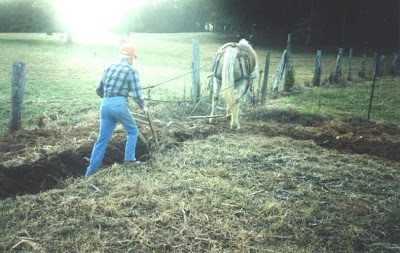
Clyde never complained and never seemed to break a sweat. It was almost comical to see my 98 pound papaw holding back on the reigns and yelling out commands loud enough to echo off of the surrounding stand of Oak trees. "Gee, haw, geediyap, whoaaa, git-round-yaar," I would often imitate his commands and pretend that I was leading the big Clydesdale.
One wonderful and terrible day, papaw gave in to my pleading and allowed me to drive the rail-sled down the hill to the barn. "Don't go in that pond," was the last thing I remember him saying as I led Clyde straight into the pond, pulling me and papaw along behind him on the sled. That was the last time I got to drive Clyde, but that was OK, I was content to sit back and enjoy the ride!
 Before I begin, I just want to say, neither I nor anyone here at HS is advocating any illegal act, including the production, transportation, or consumption of untaxed liquor. Seriously.
By the time the United States entered World War I, there were twenty-six dry states. At least they prohibited the saloon and retail liquor traffic. They did not, however, prohibit the manufacturing of liquor. After all, whiskey-making was a major industry, particularly in the South. North Carolina, for instance, had 733 licensed grain distilleries in 1895 and more than 1,300 legal fruit distilleries, turning out over a million gallons of whiskey and brandy a year. The illicit industry was even bigger (much bigger!) - a situation that held true throughout most of the Appalachian Southeast.Damn.
Rum by many is preferred
And brandy makes its boast.
The Dutch and English like their gin
And ale goes well with roast.
Requests for rye in Eastern States
Quite Frequently are heard,
And the hill folk of the Southlands
Make corn a favorite word . . .
- Anonymous (MMS I, 4: 79)
W.J. Cash, in his The Mind of the South, noted that, as the politicians saw it, "Cuffey [a colloquial synonym for Negro], when primed with a few drinks of whiskey, was lamentably inclined to let his ego a little out of its chains and to relapse int the dangerous manners learned in carpetbag days - to pour into the towns on Saturday afternoon and swagger along the street in guffawing gangs . . . It seems genuinely to have been believed that to forbid the sale of legal liquor, and so presumably to force up the price of the bootleg product, would be to deprive him of alcohol altogether and so make it easier to keep him in his place. Certainly the argument was much used in winning over the hard-drinking poor whites."
But there was considerable wet sentiment in the South - mainly among the moderates and the realists who wanted to see liquor remain legal but controlled. In 1907, Captain Swift Galloway of Greene County told the North Carolina House of Representatives that he was upset by the rising dry sentiment:There is an era of fanaticism upon this country, that came here along with the epizootic, the trippe and hog cholera. It came here from the Puritans who landing at Plymouth Rock, who first go on their knees and then on the aborigines. I sometimes feel like wishing that instead of their landing on Plymouth Rock, Plymouth Rock had landed on them. They tell me that in some sections of this State you have laws which make a man a criminal if a certain amount of liquor is found in his home and that a . . . upstart policeman has a right to break into that sacred home, to find out if he can find it. I do not hesitate to say that if I lived in a community of free men who would submit to such a tyranny, I should want to get an occasional furlough and get relief from outraged feelings by brief visits to hell.
Intriguing, eh? It reminds me of the "war on drugs" that still rages today, a war which seeks not the practical goal of controlling drugs, but of "obliterating" their use - something that no rational man or woman assumes possible. More to the point, however, it reminds me of the patently economically discriminatory punishments attached to drug enforcement laws - punishments for the drugs of the poor (not just dealer's punishments, which I can accept, but user's punishments), such as crack (a form of cut and adulterated cocaine), are radically more oppressive than those for drugs usually used by wealthy patrons, such as unadulterated cocaine.

….Why we should acknowledge the sins of our fathers
by April A. Cain copyright 2007
Author's note...Portions of this essay without references to Appalachian Virginia were first published at www.thewomenspost.wordpress.com
On January 10, 2007, Delegate A. Donald McEachin and State Senator Henry L. Marsh offered a resolution in the Virginia General Assembly which would constitute the General Assembly’s atonement, on behalf of the Commonwealth, for the slavery of Africans. The resolution also calls for healing and reconciliation which the bill’s summary states “are possible with the acknowledgement of past grievous indignities and injustices”. The resolution has been referred to the House Committee on Rules. If you want to read the full text of the resolution, here is one link: http://www.richmondsunlight.com/bill/2007/hj728/.
The introduction of this resolution has caused quite a stir, particularly in the Commonwealth’s capital city of Richmond, which of course also once served as the capital of the Confederacy. While Yom Kippur, the Jewish observation of the Day of Atonement, happens in September or October each year, I am not Jewish. But as a Christian, with Lent right around the corner (the nearest Christian observation I can think of that roughly equates to a season of atonement), I thought I would reflect upon the proposed resolution and make some confessions of my own.
You see, I am a Daughter of the Confederacy. It’s not a phrase which I have ever used to describe myself, and I have never even considered belonging to any formal organization which might seek to bestow that title upon me. But by the definition which has evolved in the post-Civil War South, I am one. My Great Grandfather, whose first and middle names were “George Washington”, left his home in the mountains of Eastern Kentucky when the war began and joined the fight for the cause. If you are a student of Civil War history, you might wisely ask “which cause”? Kentucky never actually left the Union. It was officially “neutral”, which did not make the Bluegrass State a part of the Confederacy. But Great Grandpa left Kentucky and joined the Confederate Army to fight for the side he thought of as morally and politically right.
“G.W.” was also a slaveholder, which in the limited research I’ve done over the years on the subject, made him quite unusual in the mountains of Eastern Kentucky. I know that at least in far Southwest Virginia where I grew up, people hadn’t gotten as riled up about the cause of the Old South as elsewhere. They were too busy just trying to survive and didn’t have a lot of wealth or property (human or otherwise) to defend. I know the Civil War was more than just about slavery, but slavery was a significant part of the struggle to retain “state’s rights”. Let’s not kid ourselves.
Students of Virginia history tell me that in Virginia we stubborn mountaineers west of the Blue Ridge were always viewed with suspicion by the other seceders,. They weren’t sure how loyal we were, particularly after our friends in adjacent counties split off and formed West Virginia or “seceded from the Confederacy” (A joke my dad used to make). We Southwest Virginians were culturally and genetically descended from the same stock as our West Virginia brethren, so I’m sure a lot of folks wished they could stay with the Union, too. I don’t ever remember my parents speaking much of G.W.’s actions during the Civil War. I was never encouraged to take pride that he had once fought for the South. The first time, perhaps the only time, I ever heard my mother make mention of it to me was a tongue in cheek remark she made when I was I was a very young adult. I called her when I was applying for a position with a government agency, to read her a statement which I was required to sign to the effect that neither I, nor any member of my family, had ever been part of an organization whose purpose it was to overthrow the United States Government by unconstitutional means.
She laughed and replied, “Well, you’d better tell them about your daddy’s grandaddy”. . .
When I moved to Louisville, Kentucky a couple of years later I was excited to meet lots of cousins I only barely knew, or whom I had not known at all. I learned that some of them took our Great Grandaddy's participation in the Civil War quite seriously as a matter of pride and heritage. I’ve never been able to relate to those feelings. It’s certainly not how I was raised. I don’t revere the cause of the South, which would have resulted in the continuation, at least in part of North America, of a system in which human beings were bought and sold as chattel.
And I have never been able to separate G.W.’s participation in the war, for a side which did not conscript him, from his role as slaveholder. I will never be convinced that his roles as Confederate soldier and as slaveholder were unrelated, and I would imagine that if the South had won the war he would have gathered up his belongings, including the people he “owned” and headed straight for the Virginia border at Pound Gap. Why else would he have risked his life unless it was to defend the manner in which he lived?
That brings us to what I’ve heard as the most common argument made against passage of the current resolution, that being that the people involved in the Civil War are all dead and we don’t have nuthin’ to apologize to nobody about…..
I for one am quite sure that my father’s family benefited economically from slave labor, which has ultimately benefited me. And yes, I realize that there are immigrants in this Commonwealth, from other countries and other regions of this country, whose ancestors didn’t give a hoot about, or didn’t even know about, the slave based economic system that helped build the infrastructure of this state. But no one is being asked to make a personal apology. This is a resolution simply asking our Commonwealth, this beautiful and living, breathing, growing entity where we live and work (and where some of us were born), to acknowledge some painful things that it did. And our Commonwealth should atone. It’s a gesture that could bring comfort to many whose forebears paid a grim price for what was done in our state’s name.
The death of a participant (either human or political) in history had never stopped anyone from giving credit where credit is due, or seeking credit where credit is due. For example, when our family visited France a couple of years ago, my husband raised his eyebrows as he and my son read the translation of the inscription on a World War II monument. “Look at this…. ” He motioned for me to come over and look. “They talk about how they defeated the Nazis but they don’t seem to think it’s important to mention the role of the Allies in the victory. Hah!” Yes, everyone, or most everyone is dead, but he and I both felt they should have given tribute where tribute was due.
Another time someone actually gave me such a tribute. I was with a group, and an extremely tall man in high boots came up to us and took his hat off to us. He was Russian and he told us he was 93 years old. In a dramatic voice and with tears in his eyes he told of the terrific battles he had fought during World War II. Our translator was almost crying, too, as he conveyed to us how much this gentleman loved Americans for having helped saved Russia from Hitler. I cannot remember ever feeling prouder of my country.
While my (deceased) dad hadn’t been starving at the Siege of Leningrad of course, he had spent most of the war at a submarine base in Key West, Florida doing his own part to save the world. I felt as puffed up as a peacock. Like Sally Field at the Academy Awards. “They like me”. I thought. “They really like me”. I felt entitled to take credit for the good things my country had done, and I challenge anyone, whether or not they are a son or daughter of the Confederacy, to say they wouldn’t have reacted with the same smug pride as I did on that day. So if we feel we can take credit for what dead people do, why do we feel we shouldn’t make atonement for what dead people have done?
Whether or not we were personally involved, shouldn’t those of us who live here be sorry that this Commonwealth once endorsed a cruel and morally indefensible system? I’d guess that the majority of people living in Virginia whose families were lucky enough to have avoided the holocaust at least have World War II veterans in their families. And if the Chancellor of Germany wanted to offer an acknowledgment of and atonement for all the misery the German government unleashed on this sorry world during the 1930’s and 40’s, causing suffering in some way to our parents, grandparents or great grandparents, none of us would say, “Oh no. It’s o.k. Those people are all dead now. Nobody living in Germany needs to feel the least bit bad about it”. No, we’d accept the gesture without hesitation. Arguing that everyone involved is dead or that a corporate expression of atonement is somehow a personal apology just doesn’t make any sense. And it’s ironic to me that the people who are saying African Americans need to move on are likely the same people who objected to the placement of a statue of Abraham Lincoln in downtown Richmond because they themselves weren’t ready to put the past behind them.
We can’t put the past behind us until we acknowledge the past for what it was. For the life of me I can’t understand what it would hurt to do just that.
April A. Cain is an attorney, writer and mother who lives in Richmond, Virginia. She is a native of Saint Paul (Wise County) Virginia.
The advent of steam locomotion and the discovery of coal in the Appalachian Mountains brought about some of the most significant transformations to the region since its European settlement. A multitude of short-line and regional railroads began appearing near the turn of the century and would prove instrumental in the development of the region's natural resource economy. All are today incorporated into either the Norfolk Southern Corporation or CSX Corporation.
This is the first part of a series that will highlight this important part of our history, the Appalachian Railroads.
 2-8-0 #2 at Glamorgan in 1941, from the C.K. Marsh, Jr. Collection