Showing posts with label Georgia. Show all posts
Showing posts with label Georgia. Show all posts
Wednesday, December 02, 2009

Tuesday, December 04, 2007
Cherokee Voices: Early Accounts of Cherokee Life in the East

(Image of the cover of Cherokee Voices: Accounts of Cherokee Life before 1900 by Vicki Rozema, published by John F. Blair Publisher)
So often in our lessons (both taken as students and given as instructors) what we call "history" is hardly history at all. It is selected interpretations of events, emphasizing our someones' (ours included) goals. Inconvenient truths are consciously or unconsciously excised, left behind to emphasize the villainy or innocence of one party or another, minor events swell in their apparent importance with time (and after the "winner's editing"), and so on. Now, I hardly think that every history book writer or teacher, formal or informal, has a conscious political-economic goal set leading them to propagandize (though some certainly do). But between winners' need to justify their win (victory always being the successful domination of one or more parties through coercion, threats of coercion, or bargaining to achieve unequal goods), survivor's desires to both justify their survival and to reiterate their ancestor's value (eg. they lost but only because of rule-violation), and "-ists" of all kinds need to demonstrate the properness of their respective "-isms", well, history tends to become, well, something else.
Thus my attraction to first-materials, both for teaching and for learning. Sure, reading a book about the Constitution is sometimes a good decision, but it is a helluva' more important undertaking to read the thing itself (repeatedly, frankly) . . . not to mention its predecessors, the contemporary arguments of those who made it, and the official justifications of its passage (The Federalist Papers, if you were wondering).
This leads me to my laud for Rozema and others of her ilk. Far to rarely are first materials drawn together for easy consumption of subjects that less popular (or rather have fewer proven markets) than, say, American Constitutionalism, despite their genuine importance. Academics have a tendency to sneer at their peers who focus exclusively on such work (I have heard more than one peer refer to such collections as mere "textbook fodder"), while normal folks are rarely pushed to seek them out (especially since, if they include works in excess of 150 years old, they're generally written off as simply "hard to read," a symptom of our "write to the six-grade level" culture).
Rozema, however has chosen a tremendous subject. She collects works dating back into the early 18th Century. She concentrates on a subject (British-Cherokee and American-Cherokee political, social, and economic discourse and negotiation) that hardly has common appeal (especially since it does not concentrate on the Cherokee people as either a model of utopia or a warrior culture and certainly not as a Romantic epic). She annotates her work, but sparingly, letting it speak for itself - I wish I was half as elegant and precise. And through reading words that she "merely" found and brought together, she outlines the ever greater intersection of British-American culture with that Cherokee (as well as several other peoples), an intersection that yields tremendous truths about acculturation, assimilation, conquest, cultural preservation, and the seeds of the Cherokee people's survival in modern America (a success many, if not most, native American peoples sadly did not achieve). To say I admire this work is an understatement; I wish only that it was longer, that the picture was fuller, rounder. Oh - and I wish it had maps . . . many, many maps.
I don't want to give away too much, because this is a book that deserves to be purchased. I just want to tell you that the exchange of documents regarding the assault of Hanging Maw and his family and friends reads like shortened version of the long relationship between British and American authorities and those of the Cherokee - one of promises from well-meaning parties being unable to prevent the predations of parties damned and determined that cohabitation simply wasn't an option. It is this theme, along with that of a Cherokee people who constantly adapt to British and American political-economics at first as a way of gaining power and influence (as well as certain key goods), but who ultimately become dependent on that political-economy, rendering them essentially conquered long before their lands were entirely seized, but ironically leaving them better prepared to preserve other parts of their culture after conquest. The story, if it can be called that, is in other words complex - - - there are no simple answers, because no matter what the high school history textbooks my tutorees are issued proffer, the conquest of the native American nations cannot be summarized in half-page essays. There are untold lessons our people, our democracy, needs, both moral and practical, in these original documents, hard lessons that sanitized history simple cannot and does not teach.
In summary, this is a damn fine book - a quick read (157 pages, though the official website indicates less) that is so good that should I see an updated, expanded edition (hint hint, wink wink) I won't hesitate to buy it. But I know what you want - - - so here they come.
Publisher's Official Site
Vicki Rozema's home page
Seriously - all fancy words aside, this is a great work, not only for students of the Cherokee people, but for students of intercultural (and inter-systemic) relations in general. And, of course, for us Appalachians, it is a record of one of the most crucial junctures in our region's history.
Sunday, February 11, 2007
Joseph Earl Dabney: Moonshine Spirits
". . . Aye Goddd, drinking Cokee Coley
and smoking cigarettes are going
to be the ruination of this country.
Now this corn cob pipe and a morning
swig of corn whiskey - they are
absolute needcessities. . . . "
- Old time Appalachian mountaineer Gid Moon
of Greenville, South Carolina
(as quoted in More Mountain Spirits, 77)
and smoking cigarettes are going
to be the ruination of this country.
Now this corn cob pipe and a morning
swig of corn whiskey - they are
absolute needcessities. . . . "
- Old time Appalachian mountaineer Gid Moon
of Greenville, South Carolina
(as quoted in More Mountain Spirits, 77)
 Before I begin, I just want to say, neither I nor anyone here at HS is advocating any illegal act, including the production, transportation, or consumption of untaxed liquor. Seriously.
We've all done it - read a book, heard an album, seen a show or a movie, tried out a new restaurant, and annoyed our friends for ages over it. With books this habit is probably at its worst - the annoyer constantly contradicts him or herself, insisting the annoyee (so not a word) both read the work and wait until the annoyer has completed the work, "you know, so I can tell you it really was good."
I know about this phenomenon largely because, sigh, I am just this kind of annoyer.
My most recent instance of engaging in this phenomenon, at least in the literary world, lies in the work of Joseph Earl Dabney's two book Mountain Spirits series (more specifically, volume one is entitled Mountain Spirits: A Chronicle of Corn Whiskey from King James' Ulster Plantation to America's Appalachians and the Moonshine Life and volume two is entitled More Mountain Spirits: The Continuing Chronicle of Moonshine Life and Corn Whiskey, Wines, Ciders & Beers in America's Appalachians). I found these books, first published in 1974 and 1980 respectively, in a discount bookstore here in Knoxville, in the local history and culture section, and nearly passed them up - moonshine is interesting, of course, but did I want to read a two volume socio-historical diatribe on the subject? Ultimately, the discount price grabbed me and I bought both books (on two separate days, however) - my only response is "thank goodness."
I don't know how to best describe the books beyond summarizing and quoting some key sections - they cover virtually every imagine subject related to alcohol production, marketing, interdiction and consumption in Appalachia (and those regions throughout the Union which consume Appalachian alcohol) across a vast swath of history - before, in fact, liquor of any kind was being manufactured in the territory that would become the United States (possible exceptions - if Spanish settlers produced rum or other liquors in their colonies in Florida, the Southwest, or Puerto Rico). My documentation, by the way, will be as such:
MS = Mountain Spirits
MMS = More Mountain Spirits
(Section, Chapter: Page)
MMS = More Mountain Spirits
(Section, Chapter: Page)
Thus, let me tease you:
MS (II, 3: 31-41) This is one of the definitive sections of the series - it reviews the amalgamation of Scottish and Irish techniques of distilling and distributing their liquors through first the colonization of North Ireland (and the Appalachians) by Scots seeking religious and economic freedom. Now, this section interested me because of my interest in two key points - first, to what degree did Ulstermen connect religious freedom to economic freedom (ahh, Weber), and second, should NASCAR fans actually be tracing the origins of their sport to the British and Irish coves, carts, and boats which liquor salesmen would use to smuggle their very special water.
MS (II, 4: 42-57) Another fascinating section, this chapter, among a great other topics discusses the role whiskey-making Ulstermen played in accelerating the rate of European colonization of the American "west" - including the Midwest, Appalachia, and the width and breadth of the Louisiana Purchase, an interesting subject to me given my interest in both development and the parallels between the expansion of the American Union and the Roman Republic (and later Empire). Another key subject in this chapter is that it explains clearly and elegantly why Appalachian farmers, both Scotch-Irish and their neighbors who adopted this part of the Scotch-Irish tradition, often turned to moonshine. Ultimately, moonshining in the Appalachians (at least from the colonization period up through the tide or Prohibition) was a product of three converging structural elements: (1) inadequately developed transportation infrastructure, (2) the high resale value of processed corn (as liquor) versus unprocessed corn, and (3) the predominance of small, yeoman farmers (as in New England) rather than large-scale plantation-style agriculture (like that which dominated the rest of the South) thereby redoubling the relative costs of trying to rely on unprocessed goods for their monetary incomes. In other words, to paraphrase one of my favorite Scotsman (fellow by the name of Adam Smith), the moonshiners rationally interpreted their relative economic advantages and disadvantages and acted accordingly. (also see MS III, 9: 117- 130)
MS (II, 5: 58-73) Wow wow wow. The best discussion of the causes and history of the Whiskey Rebellion (where Washington, prodded on by Hamilton, crushed a frontier rebellion that, like the American Revolution, was in large part a product of taxation of a beverage) I've ever digested, not to mention the most interesting portrayal of Jefferson as sharing the interests of Appalachians in particular and independent farmers in general I've ever heard of. Fascinating to the umpteenth degree, it demonstrates the messiness that actually accompanied the rise of the Union, rather than the clean and crisp interpretation we're normally sold in our textbooks.
MS (II, 8: 104) Just a simple quote here, to give you a sense of the scale of the once tremendous national market for small-batch distilleries prior to national Prohibition.
By the time the United States entered World War I, there were twenty-six dry states. At least they prohibited the saloon and retail liquor traffic. They did not, however, prohibit the manufacturing of liquor. After all, whiskey-making was a major industry, particularly in the South. North Carolina, for instance, had 733 licensed grain distilleries in 1895 and more than 1,300 legal fruit distilleries, turning out over a million gallons of whiskey and brandy a year. The illicit industry was even bigger (much bigger!) - a situation that held true throughout most of the Appalachian Southeast.Damn.
MS (III, 11: 148- 165) A masterful, well-written essay on "tripping" - the process of moving illegal alcohol from the manufacturers to the distributors in the Prohibition period, and about how this process led to the dawn of American autoracing, and ultimately, NASCAR.
MMS (I, 2: 33-48) The title tells it all here - - - "Mountain Wines, Ciders, and Beers." Ahha! Alcohols that can be manufactured by small craftsmen legally - at last. Ultimately, this one reads like a classic, 19th Century receipt book - you'll find receipts on cider, elderberry wine, mountain beer, peach beer, persimmon beer, tomato beer, scuppernong wine, pumpkin gin, grape wine, mead, parsnip wine, and rhubarb wine. My mouth is watering - for everything but tomato beer, at least. Similar receipts for something less, well, legal are found in the next chapter (I, 3: 51-70) as well - one which details the tremendous variety of brandies produced, formerly and/or currently in the Appalachians, including split brandy, apple brandy, apple/syrup brandy, Hog Sweet Apple brandy, Streaked June Apple brandy, peach brandy, crabapple brandy, plum brandy, and blackberry brandy.
Also, the series provides tremendous information on the craft and lifestyle associated with the manufacture of backcountry liquor, beer, and wine. That's not to say that Dabney supports the illegal manufacture of alcohol, quite the contrary. What it is to say, however, is that Dabney supports the manufacture of alcohol as a craft and the craftsmen who partake in the artform. Indeed, Dabney also dedicates tremendous time and effort to the lawmen who seek to suppress the illegal manufacture the liquor, an act which he admires just as much (see in particular MMS II, 8: 183-197). In particular, Dabney seems interested in the fact that lawmen who treat shiners fairly tend to be accepted in their communities, while non-lawmen who sell out their neighbors are regarded as traitors and receive the animosity of their community. Obviously this behavioral pattern is neither unique to illegal alcohol manufacturing nor to Appalachia - sociologically an intriguing case-study.
One of my favorite chapters is section III, chapter 10 in MS. The title? "The Moonshine Pockets". The push of it? Subsections on, among others, Dawson County, GA; Cocke County, TN; Wilkes County, NC; Greene County, TN; Sneedville, TN; and the Dark Corner of South Carolina - with apologies for not covering Franklin County, VA or the remainder of Appalachia, the Ozarks, and Oklahoma.
Insert random quote here:
Rum by many is preferred
And brandy makes its boast.
The Dutch and English like their gin
And ale goes well with roast.
Requests for rye in Eastern States
Quite Frequently are heard,
And the hill folk of the Southlands
Make corn a favorite word . . .
- Anonymous (MMS I, 4: 79)
But there is more - Dabney writes biographies with an attention to detail, particular the ethical and rational ironies and paradoxes that punctuate the men and women he's portraying, not to mention their place in their contemporary political economies - my favorites?
MS (II, 7: 90-101) The true story of "Uncle" Amos Owens, the Cherry Bounce King.
MS (III, 10: 138-139) The equally true story of "Big Betsy" aka "Aunt Mahala" aka the "Moonshine Queen" Betsy Mullins, a 450 lb. (some reports claimed 600 lb.) Melungeon (or, more properly Portygee) who dominated the region's moonshining market.
MMS (I, 1: 17-29) The similarly true story of Simmie Free, one of Dabney's closest sources for his books and a classic example of the moonshiners-as-craftsmen that Dabney enshrines.
Let me come to a close here by noting that two key themes run through both books: what were/are the causes and consequences of alcohol prohibition (and the stricter variants of regulation) in particular, both in the various states and municipalities and in the Union as a whole?
Key among the causes? An alliance between unlikely political partners - Christian fundamentalists, liberal progressives (including, but not exclusively, early American feminists), and elitist, um, bastards? Consider:
1. Christian social conservatives sought to save folks from themselves, noble enough, even if you don't agree with the sentiment, noting that crime and domestic violence are often correlated with substance abuse. Of particular, but by no means exclusive, importance among this genre were the more conservative variants of Baptist and Methodist theologies.
2. Liberal progressives and feminists sought prohibition for, well, exactly the same reasons - sure, they couched their arguments in different terms (well, sometimes - remember, there were and are Christian progressives, for instance), but their ends were essentially the same - save the normal man (and his family) from the demon of alcoholism.
3. Elitist bastards - ah, well, this refers to all sorts of sub-classes of people I flatly don't like. In essence, these were people who generally constituted the politically and economically dominant class in their region and who considered most of their society's ills to be the fault of the politically and economically dominated class(es). In some places, this meant immigrants from Eastern and Southern Europe and Ireland, in others Catholics, in others native Americans, in some Americans of African descent, and in many all or most of these groups. These folks felt that alcohol had the effect of making the dominated class(es) "uppity," more likely to express their outrage at being discriminated against and/or exploited. Let me quote a broad section from pages 104-105 of Mountain Spirits here:
W.J. Cash, in his The Mind of the South, noted that, as the politicians saw it, "Cuffey [a colloquial synonym for Negro], when primed with a few drinks of whiskey, was lamentably inclined to let his ego a little out of its chains and to relapse int the dangerous manners learned in carpetbag days - to pour into the towns on Saturday afternoon and swagger along the street in guffawing gangs . . . It seems genuinely to have been believed that to forbid the sale of legal liquor, and so presumably to force up the price of the bootleg product, would be to deprive him of alcohol altogether and so make it easier to keep him in his place. Certainly the argument was much used in winning over the hard-drinking poor whites."
But there was considerable wet sentiment in the South - mainly among the moderates and the realists who wanted to see liquor remain legal but controlled. In 1907, Captain Swift Galloway of Greene County told the North Carolina House of Representatives that he was upset by the rising dry sentiment:There is an era of fanaticism upon this country, that came here along with the epizootic, the trippe and hog cholera. It came here from the Puritans who landing at Plymouth Rock, who first go on their knees and then on the aborigines. I sometimes feel like wishing that instead of their landing on Plymouth Rock, Plymouth Rock had landed on them. They tell me that in some sections of this State you have laws which make a man a criminal if a certain amount of liquor is found in his home and that a . . . upstart policeman has a right to break into that sacred home, to find out if he can find it. I do not hesitate to say that if I lived in a community of free men who would submit to such a tyranny, I should want to get an occasional furlough and get relief from outraged feelings by brief visits to hell.
Intriguing, eh? It reminds me of the "war on drugs" that still rages today, a war which seeks not the practical goal of controlling drugs, but of "obliterating" their use - something that no rational man or woman assumes possible. More to the point, however, it reminds me of the patently economically discriminatory punishments attached to drug enforcement laws - punishments for the drugs of the poor (not just dealer's punishments, which I can accept, but user's punishments), such as crack (a form of cut and adulterated cocaine), are radically more oppressive than those for drugs usually used by wealthy patrons, such as unadulterated cocaine.
In the end, this book has done more to convince me of the properness of my social libertarianism - the government should not ban substance abuse, but should seek to control it and provide centers for drug and alcohol rehabilitation - it costs less and works more effectively, to be frank. Part and parcel for that? I believe that we should once more allow small batch, copper-pot liquor-making with limits similar to those for home-brewed beer and small batch wineries. The effect would be to undercut illegal moonshine business, probably permanently, and increase the number of experts on liquor making in the Union, probably ultimately leading to the kind of renaissance in this field that home-brewing has helped to lead in small-batch breweries and East Coast wineries - imagine the possible boon to Appalachian small farmers if distilleries taxes were bracketed to scale. Liquor-making might once more become a craft, rather than only a business (a state of affairs much mourned by Mr. Dabney).
Cough and ahem.
Okay, so I still haven't scratched the surface - you know why? Because there is so darn much information in these books and so much utility for the students of sociology, anthropology, and political economics that any effort I could make will, simply put, fail. To say I love these works, well, that is an understatement. Thank-you, Joseph Earl Dabney, for writing two true masterpieces.
Still not convinced you need to read these books, eh? How about a few links . . .
Bright Mountain Books (Dabney's publisher for the series)
Online Athens: "Smith: Dabney Offers Spirited Stories About Moonshine"
National Public Radio's All Things Considered: "Scuppernong Wine & Corn Bread"
Southern Foodways Alliance: "2005 Jack Daniel Lifetime Achievement Award"
Time: "Samplings for the Summer Reader"
WAMU 88.5FM American University Radio's The Kojo Nnamdi Show: "Moonshine"
Saturday, October 21, 2006
Castanea Dentata
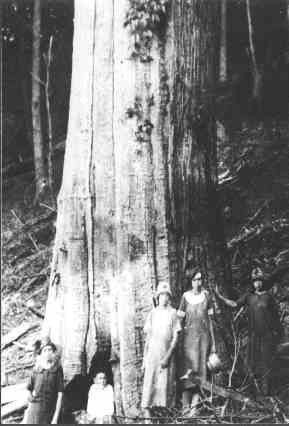
A critical commodity to the rural Appalachian economy, its wood was straight-grained, easily worked, lightweight and highly rot-resistant which made it prized for everything from lumber for home construction to furniture to split-rail fencing. Structures that date to the turn of the century were likely constructed of American Chestnut. The tree also produced nuts that were highly valuable and sought after by both people and wildlife.
However, an invasive species of fungus introduced from Asia brought a catastrophic blight to the American chestnut. First found in 1902 in New York's Bronx Zoo, the blight spread like wildfire throughout the east and within 40 years brought devastation the tree.
Specimens can still be found in the wild, but seldom greater than 20 feet tall and 6 inches in diameter. Two of the largest surviving American Chestnut trees are in Jackson County, Tennessee. One is the state champion and has a diameter of 61 cm (24 in) and a height of 23 meters (75 ft) and the other tree is nearly as large.
On May 18, 2006, a biologist with the Georgia Department of Natural Resources spotted a stand of several trees near Warm Springs, Georgia. One of the trees is approximately 20-30 years old and 13 meters (40 ft) tall and is the southernmost American Chestnut tree known to be flowering and producing nuts. Another large tree was found in Talladega National Forest, Alabama on June 2006. It is 26 meters (85 ft) tall with a diameter of 35 centimeters (14 in).
A combination of factors may account for the survival of these relatively large American Chestnut trees including low levels of blight resistance, hypovirulence (the attacking blight fungus is weakened by a virus), and good site conditions. In some cases, large chestnut trees have just been lucky and have not yet been exposed to the blight-causing spores.
Several organizations are working on restoring the American Chestnut to its historic eastern range.
The American Chestnut Foundation
Probably the most notable organization working on behalf of the American Chestnut. Based in Bennington, Vermont, ACF seeks to restore the American Chestnut by creating a blight-resistant American Chestnut by "backcrossing" blight resistance from the Chinese chestnut into the American Chestnut, while maintaining the American Chestnut’s characteristics. A blight-resistant American Chestnut tree is expected to be ready soon for forest test-planting and for wider distribution within the next decade. An American Chestnut from ACF's research farm in Meadowview, VA was planted on the White House lawn during last year's Arbor Day celebration.
American Chestnut Cooperators' Foundation
The American Chestnut Cooperators' Foundation's goal is to raise funds to support graduate and undergraduate student research projects at Virginia Tech's Department of Plant Pathology, Physiology & Weed Science, and at Concord College, West Virginia. The research makes possible seedling and nut distributions from an all-American breeding program to restore American Chestnuts to native forests.
The Canadian Chestnut Council
The Canadian Chestnut Council is a charitable organization that has been actively involved since 1988 in the development and implementation of numerous objectives in support of the American Chestnut. CCC acts as an information network for coordinating the support efforts by various Chestnut enthusiasts and research scientists across Ontario and Canada, and to communicate with similar groups in the United States and elsewhere.
Also noteworthy is an article on the American Chestnut in National Geographic Magazine.
Subscribe to:
Posts (Atom)