Showing posts with label forestry. Show all posts

Friday, August 10, 2007

Castanea Dentata Redux

American Chestnut leaves, Carroll County, Va. Photo by Will Cook, Duke University Reclaiming mined lands-good. Reintroducing a nearly extinct species of tree that once was a foundation of the Appalachian economy-even better. Combining the two efforts to not only reclaim, but reforest Appalachian mountains scarred by mining activities, totally AWESOME!

This post by jdub over at Appalachian Voice Front Porch Blog recently caught my attention. With some good links and thoughts for consideration, it highlights reclamation efforts that are coinciding with the renaissance of the American Chestnut.

Monday, May 28, 2007

Laurel Bed Lake

I was introduced to a new mountain gem this weekend. I considered myself an outdoor guru of Southwestern Virginia but more and more I'm finding new and hidden places that I had never heard of. This weekend on a fishing excursion, I was escorted to Laurel Bed Lake. On top of Clinch Mountain, at the borders of Smyth, Russell, Washington and Tazewell Counties, the man-made lake surface of 330 acres rests at 3674 feet above sea level. Being so far up and away from the closest town of Saltville (elevation 1718) made me want to find out why this lake was built. With most lakes in my area, they are to either provide water to a town nearby or electricity. It appears that Laurel Bed was made just for us to enjoy and to provide the state with additional fishing fee reveue. In an effort to find something digging a little more deeply into the history of the lake than what the site above told me, I came across the Laurel Bed Lake Liming Project. The article below by Dr. Dan Downey lays out a history of the lake as well as the efforts to preserve a habitat for native fish and eradicate an aggressor that was not intended to be in the lake.


A Brief History of the Liming of Laurel Bed Lake
By Dan Downey


Laurel Bed Lake is a 330 acre high mountain impoundment located in the Clinch Mountain Wildlife Management Area (CMWMA). The CMWMA is a 25,000 acre piece of mountainous real estate that was acquired for Virginia hunters and fishermen in early the 1960s with revenues raised from fishing and hunting licenses. A central feature of this property is a picturesque stream known as Big Tumbling Creek that flows several miles down through a steep and narrow gorge filled with rhododendron and mountain laurel. When the CMWMA was created, times were different for trout fishermen in the Commonwealth and the name of the game was catch and keep. The trout season back then consisted of several stockings of catchable sized fish in the months of April and May, with most of the fish caught out soon after the season opened. In an effort to provide for a longer trout season and the opportunity for people to fish over freshly stocked trout, Big Tumbling Creek was made into a fee fishing trout stream. Under this regulation, trout are stocked daily (except Sunday) and fishermen pay a daily fee to fish for them. The fee fishery was very popular when it was initiated, attracting more than 35,000 people per year. (However, times have changed - with the many special regulation streams we have now, year round trout season and other changes in the trout program, about half the number of permits are sold as in the past.) Soon after the fee fishery was established it was found that as with most headwater streams in Virginia, Big Tumbling Creek experienced very low flows in the latter part of the summer that limited fishing. To offset the low flow conditions, Laurel Bed Lake was built in 1967 on a major tributary (Laurel Creek) to provide stream flow augmentation to the fee fishing area via regulated water releases.

Obviously a large lake in a Wildlife Management Area provides an opportunity for fishing even if the main reason for its existence is stream flow augmentation. Thus the lake was stocked with brook trout (Salvelinus fontinalis) and included as part of the fee area. Unfortunately there were problems in the development of the fishery from the outset. It soon became apparent that low pH - acid conditions - were the cause of much of the trouble here. The watershed of Laurel Bed Lake is mainly low solubility siliciclastic rock. It provides very little natural buffer to offset the acid rainfall of the region. In addition, the lake was built on top of a wetland, which is naturally acidic. So in the 1970s, Bob Wollitz and John Jesse, the regional fisheries biologists at that time, added 60 tons of slaked lime to the lake to increade alkalinity. This was done manually by slurrying the material from a boat. This effort had remarkable results: aquatic vegetation established and the stocked brook trout resident in the lake grew fat from an abundance of aquatic insects. These were the glory days of the "bed" that many of the local fishermen still talk about. Catches of a hundred fish per day - with some in the 16" to 18" range - were not unusual. Unfortunately, however, things took a turn for the worse. First, rock bass (red-eyes or goggleyes, Ambloplites rupestris) became established in the lake. These small sunfish are often called the "schoolboy's friend" because they are prolific and easy to catch. But in Laurel Bed Lake, they were considered to be a nuisance fish as they outcompeted the brookies for the aquatic insect food supply and trout growth rates decreased. Worse yet, within a few years the pH of the lake gradually dropped. These things caused the brook trout fishery to become dependent on annual put and take stockings and there was little carry over of trout from year to year.

In 1996, the new fisheries biologist for the region, Tom Hampton, was handed the task of "re-making the bed" - to try to restore the fishery as before. Tom asked Dr. Dan Downey of JMU, who has done extensive research on surface water acidity and liming in Virginia, to assist in this project. The lake, its feeder stream, physical characteristics and water chemistry were studied in great detail. It was found that the lake was averaging pH 4.9 in 1995 and 1996. Clearly the fishery could only be reestablished by raising the pH with lime once again. It was decided to use a three prong approach to liming: first the feeder stream would be treated with a helicopter to deliver the limestone to the headwaters. This was the same approach that had successfully been developed for liming streams in the National Forest, such as the recently treated St. Mary's Wilderness. Then the upper lake shoreline, where there is a lot of wave action, would be limed. Finally the main body of the lake would be treated with lime directly. The idea here was to raise pH and other water quality parameters (WQPs), such as base cation concentration, as soon as possible, then to maintain this pH with a minimum of reapplications. Things became complicated from the outset. First, the concrete riser at the lower end of the lake, which contains the water release gate, had to be repaired. As it turned out, this reconstruction effort later necessitated the draining of the lake. Then the first phase of liming did not go well. The feeder stream was to be limed in November 1996. After only a few trips, the feeder stream liming had to be abandoned due to hazardous flying conditions, so the upper lake shoreline was treated with the limestone that was supposed to have been placed in the stream. In 1997, the lake was drained for the repair work. The residual water was treated with rotenone to remove the stunted population of red-eyed sunfish that had naturalized in the acidic lake. By the fall of 1997, the construction was finished and the lake was slowly refilled. Approximately 90 tons of aglime was slurried into the lake in a three day period in October, 1997. Concurrently over 15,000 brook trout fingerlings, four to six inches in length were introduced. With winter snows and rain, the lake had refilled to full pool by February, 1998. The WQP's were significantly improved, such as the pH values increasing from 4.9 to 6.5 and acid neutralizing capacity values increasing from negative values to good positive values.

By the spring of 1998, it was apparent that the brook trout had not only survived through the winter, but had grown and were doing quite well. Netting in the fall of 1998 revealed that they had grown to nine to thirteen inches in this one year period. A second lake liming was then conducted in October 1998 with over 150 tons of aglime slurried into the lake. Another 22,000 brook trout fingerlings were then introduced. The netting and other surveys revealed that the red-eye sunfish population had returned, either as a result of illegal introductions by fishermen or because they were not completely exterminated when the lake was down. After careful consideration, 8000 smallmouth bass (Micropterus dolomieu) fingerlings were introduced to provide a predatory fish which could control the red-eye sunfish. Smallmouth bass had previously been stocked in this lake years ago but had not survived. That was done, however, when the pH was low. Electrofishing along the shoreline in the spring of 1999 revealed that the smallmouth bass survived the winter and were doing well. There were large numbers of brook trout in the lake in the 10-14" range, with a few fish near 16" length, indicating a healthy population and good growth rates. By the year 2002, the lake had also become an outstanding smallmouth bass fishery with some bass exceeding 17" in length.

As mentioned above, Laurel Bed Lake is drawn down in the summer months to augment the flow of Big Tumbling Creek. This discharge releases much of the lime treatment. Thus maintenance liming has been done in the fall months to replenish the material lost to discharge or used up in the treatment of the acidity of the lake. It is expected that the lake will continue to be a popular fishery for brook trout and eventually also produce good smallmouth bass fishing. Thus liming has been found to be a successful tool for improving water quality habitat in this lake.

Saturday, October 21, 2006

Castanea Dentata

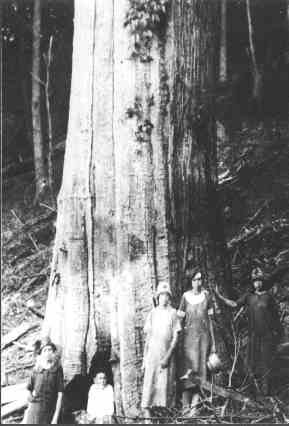
Courtesy Great Smoky Mountains National Park Library

The American Chestnut was king among trees in the eastern forests. At one time, it dominated the Appalachian mountains from Canada to Georgia and was estimated at a population numbering 4 billion or 25 percent of the eastern forest population. And it was BIG, growing up to 150 feet tall and 10 feet in diameter!

A critical commodity to the rural Appalachian economy, its wood was straight-grained, easily worked, lightweight and highly rot-resistant which made it prized for everything from lumber for home construction to furniture to split-rail fencing. Structures that date to the turn of the century were likely constructed of American Chestnut. The tree also produced nuts that were highly valuable and sought after by both people and wildlife.

However, an invasive species of fungus introduced from Asia brought a catastrophic blight to the American chestnut. First found in 1902 in New York's Bronx Zoo, the blight spread like wildfire throughout the east and within 40 years brought devastation the tree.

Specimens can still be found in the wild, but seldom greater than 20 feet tall and 6 inches in diameter. Two of the largest surviving American Chestnut trees are in Jackson County, Tennessee. One is the state champion and has a diameter of 61 cm (24 in) and a height of 23 meters (75 ft) and the other tree is nearly as large.

On May 18, 2006, a biologist with the Georgia Department of Natural Resources spotted a stand of several trees near Warm Springs, Georgia. One of the trees is approximately 20-30 years old and 13 meters (40 ft) tall and is the southernmost American Chestnut tree known to be flowering and producing nuts. Another large tree was found in Talladega National Forest, Alabama on June 2006. It is 26 meters (85 ft) tall with a diameter of 35 centimeters (14 in).

A combination of factors may account for the survival of these relatively large American Chestnut trees including low levels of blight resistance, hypovirulence (the attacking blight fungus is weakened by a virus), and good site conditions. In some cases, large chestnut trees have just been lucky and have not yet been exposed to the blight-causing spores.

Several organizations are working on restoring the American Chestnut to its historic eastern range.

The American Chestnut Foundation
Probably the most notable organization working on behalf of the American Chestnut. Based in Bennington, Vermont, ACF seeks to restore the American Chestnut by creating a blight-resistant American Chestnut by "backcrossing" blight resistance from the Chinese chestnut into the American Chestnut, while maintaining the American Chestnut’s characteristics. A blight-resistant American Chestnut tree is expected to be ready soon for forest test-planting and for wider distribution within the next decade. An American Chestnut from ACF's research farm in Meadowview, VA was planted on the White House lawn during last year's Arbor Day celebration.

American Chestnut Cooperators' Foundation
The American Chestnut Cooperators' Foundation's goal is to raise funds to support graduate and undergraduate student research projects at Virginia Tech's Department of Plant Pathology, Physiology & Weed Science, and at Concord College, West Virginia. The research makes possible seedling and nut distributions from an all-American breeding program to restore American Chestnuts to native forests.

The Canadian Chestnut Council
The Canadian Chestnut Council is a charitable organization that has been actively involved since 1988 in the development and implementation of numerous objectives in support of the American Chestnut. CCC acts as an information network for coordinating the support efforts by various Chestnut enthusiasts and research scientists across Ontario and Canada, and to communicate with similar groups in the United States and elsewhere.

Also noteworthy is an article on the American Chestnut in National Geographic Magazine.