Sunday, February 18, 2007

A Night at the Lyric

Despite being a college town, Blacksburg, VA isn’t exactly known as a hot bed of live music outside of Virginia Tech's music department. At one point in time, there were several great places to catch live music on a weekly basis. The stage at the South Main Café would frequently host groups like the Dave Matthews Band, REM, The Pietasters, Hootie &TBF, The Kind and so on before they hit the big time. This stage is long gone and the building (originally a church built by slaves, for slaves) now hosts a fish taco stand. Other venues have come and gone through the years with the popular form of “live music” in the bar setting these days coming from a DJ’s mixing board. I blame the influx of urbanite students from Northern Virginia and New Jersey for the uprising in demand for two turn tables and a microphone. All is not lost. We still have a few places that host a bring your own instrument mountain jam night and open mic nights as well.

One place the bucks the trend in this town is the Lyric Theatre. Once an eyesore for the town, and on the verge of being condemned in the early 1990's, a group of volunteers decided to restore the building and bring back some life to the theater. The Virginia Tech Corps of Cadets took on the renovation as a service project and monetary support from the community started flowing in. A couple of years after work started, the silver screen started showing movies again. Back around 1998, a local musician and student, Dylan Locke, wanted to bring big name acts to the stage of the Lyric so he set out to find some. Nine years later, he has brought in performers like Doc Watson, Sam Bush, Junior Brown, Derek Trucks, Mike Marshall, Joan Baez, Del McCoury and Bela Fleck. He’s also expanded his concert promotion in Southwestern Virginia to include the Jefferson Center in Roanoke, Sun Music Hall and FloydFest, both in Floyd. One month from today, on March 18, he brings two bands to the Lyric that have ties to the Blue Ridge Mountains of Virginia. Old School Freight Train calls Charlottesville home and Larry Keel resides to the west, near Natural Bridge.

"After forty years of recording acoustic music, it's not very often that a new band catches (and keeps) my attention. Old School Freight Train has done that and more. Their finely crafted tunes and innovative arrangements bring creativity, taste and wit to a broad spectrum of contemporary styles - vocal and instrumental, all firmly rooted in many traditions. They are certainly an emerging force to reckon with in today's wide world of acoustic music.” Those are the words of David Grisman, pretty high praise coming from the master of the mandolin. Since Grisman was first introduced to the group, he has invited OSFT to record an album on his label and go on tour with him. Their music varies from traditional to Celtic to progressive newgrass stylings.

Larry Keel adds his growling voice, poetic songwriting and flat picking genius to the show. Keel has performed with and written songs for numerous bluegrass and newgrass jam band legends, most notably in 2005 when the Del McCoury Band won a Grammy for their album The Company We Keep, featuring Keel’s Mountain Song. He’s been a featured performer from Merlefest to the Telluride Bluegrass Festival. Keel brings his band, Natural Bridge, to the stage with him this night. Their styling is more traditional bluegrass music in the mold of the forefathers of mountain music.

Tickets go on sale on Monday, February 19. There’s no doubt that the music starved citizens of Blacksburg will gobble these up quickly so make plans to visit the box office or web site early this week if you want to be a part of this performance.

Thursday, February 15, 2007

Welcome to the Queen

Author's note: This post, written about my "mountain man" (from the Ural Mountains of Russia) was originally posted at www.thewomenspost.wordpress.com.

I must admit to being a fan of English royalty and I’m thrilled that Her Majesty will join us in Jamestown later this spring. We here in Virginia are forgiving folks and take quite a bit of pride in our ties to the United Kingdom. Those of us with Scots Irish anchestry don't care a bit that our anchestors might not have been huge fans of the Crown. We're a welcoming people and I for one am glad she's coming to visit with us for a spell. As they say in far Southwest Virginia, we're excited that "company's comin' ". Too bad some of the folks in the Middle East can’t let bygones be bygones. The Brits have forgiven us as well. (I guess our having helped to keep British citizens from having to hang out their washing on the Siegfried line during WWII might have mended relations quite a bit).

I’ve always found it amusing that at the State Capital of Virginia there is a room paying tribute to Confederate heros, and in the same room they keep stored some sort of scepter which is apparently carried into the opening ceremonies of the General Assembly. From what I remember about it, some member of the General Assembly bought it in England a while back. They had to buy one because all of the old ones, which symbolized Virginia’s loyalty to the crown, were gathered up and melted down by the colonists during the American Revolution. So here in Virginia we seem more ready to forgive and forget the American Revolution than to move on from the Civil War. Hmmmmmmmm. Don’t ask me to explain that one.

I just went to see the movie, “The Queen” and I’d highly recommend it even to people who don’t care about British royalty for the sole reason that it is a highly insightful portrayal of the political skills of Prime Minister Tony Blair. It should be required viewing for any political junkie. In case you didn’t already know it, it’s about Blair’s enormous influence upon the British royal family during the days following the tragic death of Diana, Princess of Wales. I’d imagine that Her Majesty would rather the whole mess go away, but since the media has dredged it up again, and the British government has an ongoing investigation which has yet to be completed, I thought I’d share something I wrote about my perspective on Diana’s death a while ago and how it interweaves with global political and cultural events. If you want to read it here it is…..

The Princess in Perspective
Copyright 2007 by April A. Cain

Later this year will mark the tenth anniversary of the tragic death of Diana, Princess of Wales. The summer also marks my younger son’s tenth birthday. Despite the passage of time, there seems to be no end to the media’s preoccupation with her tortured life and the unfortunate accident in Paris which ended it prematurely. Her death, and his birth, will be forever connected in my heart and mind. In the wee hours of the morning one day in August of 1997, I sat in my pajamas on my next-door-neighbor’s couch as I and about ten other pajama-clad women ate crumpets and Stilton Blue Cheese with our tea and said a tearful goodbye to Diana. We cheered and hooted as her brother, Earl Spencer, defiantly announced to the royal family that Diana had needed “no royal title” to be Queen of all our hearts.

My fascination with the deceased Princess of Wales developed very slowly after her engagement and subsequent marriage to Prince Charles, but was due in part to the fact that I lived in Exeter, England during the summer of 1981 when the marriage took place. I was studying at there for the summer, and didn’t intend to take the night train into London for the festivities. At the time I wasn’t that interested in the British royal family. But at about 11:30 p.m., friends from my dormitory shook me awake. They warned that I was missing out on a piece of history if I didn’t drag myself out of bed and stumble to the train station with them. So I did.

We arrived into London in the pre-dawn hours, and camped out on Fleet Street to await the procession to St. Paul’s Cathedral. I was terribly sleepy. But as the crowd began to swell and the handsome bobbies lining the street gave out candy and flirted with us, I began to feel better. My friends and I took turns getting on one another’s shoulders as the carriages containing the wedding party clippity-clopped by, and we retired into a nearby pub for cake and champagne as we watched the ceremony on the pub’s television set.

At the end of that summer I left for home with lots of Diana-kitsch packed safely into my luggage. I still have the tea towel and mug, and “first day cover letter” sent to me by the local post office. The envelope displays the famous stamp of the couple upon which Charles seemingly towers over his new bride (He actually had to stand on a box for the photograph to achieve this effect.)

I was surprised at myself when I became a closet Diana fan. As a young woman I of course loved her sense of style, but as she and I both matured and the truth that her marriage was a sham and that she was desperately unhappy was revealed, I began to relate to her on a deeper level. Diana was Everywoman to me, and to countless other women.

But on the morning of her funeral, as I sat transfixed and grieving that she was gone, halfway across the world another silent, unheralded tragedy was taking place. A tragedy unknown to me. I didn’t know until a year later that as I and the world mourned Diana, our second child, sweet Sasha, had just been born in a Russian maternity hospital. He had become one of the hundreds of thousands of children who are abandoned and in state custody in Eastern Europe. Our dear little one spent the first year of his life without a mother or father. We returned from Russia with him just after his first birthday and right before the first anniversary of Diana’s death.

As newborn Sasha lay there with no one to hold or rock him, no one to feed or change him (except on a preordained schedule), and no one to coo and smile at him, hundreds of thousands of wreaths were laid at Kensington Palace in Diana’s honor, and millions like myself cried for her passing. No one gathered to cry for Sasha. No one printed a story about his loss or his precarious place on this planet. I thought about all this a year later when I realized the two events occurred within weeks of each other. It seemed to put Diana’s death in its proper place and made it less of a tragedy. She had a privileged life, with much sorrow, but also with great happiness. While she was able to cuddle and hug her own children, countless children around the world will never know the joy of a loving human touch. But for the winds of fortune, Sasha may have never come to us or to any family, and his amazing joy and love would have remained locked up forever.

I do not belittle Diana’s loss, or that of her children. It’s just that when compared to the suffering of the world’s children the tragic nature of her death is forever blunted to me. Many children die before ever knowing what it is to be loved or to love. I doubt Diana would be offended by this perspective.

I don’t know if those who have passed on really wait at the pearly gates to greet newcomers. If they do, perhaps Diana is still working her magic. I'd like to think that if she's there, she might be welcoming all the innocent children who weren’t as lucky as our precious Sasha.

April A. Cain is a writer, attorney and mother who lives in Richmond, Virginia. She is a native of St. Paul (Wise County)in far Southwest Virginia

Wednesday, February 14, 2007

Old Winters Song


Pic 1 is from Paint Creek, TN. Pics 2-4 are from Rich Mountain near Hot Springs, NC. Pic 5 is from Max Patch, NC and pic 6 is a bush outside where I live.

Tuesday, February 13, 2007

"Mountain Top Removal"

Just a quick public service announcement on short notice...

The film "Mountain Top Removal" will be presented tonight at Virginia Tech in Torgersen Hall, followed by a discussion with the filmmaker, Mike O'Connell. For more information on the film, when and where it will be shown, click here.

Update: Campus shut down at 6pm due to the "ice storm" we're having so the movie viewing, scheduled for 8pm, was not shown. I'll update you fine folks if and when it is rescheduled.

Monday, February 12, 2007

Appalachian Freeze


A coworker sent me this photo of the Cascades, in warmer weather a 60' tall waterfall in Giles County, Virginia, from this past weekend. Enjoy!

Sunday, February 11, 2007

Joseph Earl Dabney: Moonshine Spirits

". . . Aye Goddd, drinking Cokee Coley
and smoking cigarettes are going
to be the ruination of this country.
Now this corn cob pipe and a morning
swig of corn whiskey - they are
absolute needcessities. . . . "
- Old time Appalachian mountaineer Gid Moon
of Greenville, South Carolina
(as quoted in More Mountain Spirits, 77)

Before I begin, I just want to say, neither I nor anyone here at HS is advocating any illegal act, including the production, transportation, or consumption of untaxed liquor. Seriously.

We've all done it - read a book, heard an album, seen a show or a movie, tried out a new restaurant, and annoyed our friends for ages over it. With books this habit is probably at its worst - the annoyer constantly contradicts him or herself, insisting the annoyee (so not a word) both read the work and wait until the annoyer has completed the work, "you know, so I can tell you it really was good."

I know about this phenomenon largely because, sigh, I am just this kind of annoyer.

My most recent instance of engaging in this phenomenon, at least in the literary world, lies in the work of Joseph Earl Dabney's two book Mountain Spirits series (more specifically, volume one is entitled Mountain Spirits: A Chronicle of Corn Whiskey from King James' Ulster Plantation to America's Appalachians and the Moonshine Life and volume two is entitled More Mountain Spirits: The Continuing Chronicle of Moonshine Life and Corn Whiskey, Wines, Ciders & Beers in America's Appalachians). I found these books, first published in 1974 and 1980 respectively, in a discount bookstore here in Knoxville, in the local history and culture section, and nearly passed them up - moonshine is interesting, of course, but did I want to read a two volume socio-historical diatribe on the subject? Ultimately, the discount price grabbed me and I bought both books (on two separate days, however) - my only response is "thank goodness."

I don't know how to best describe the books beyond summarizing and quoting some key sections - they cover virtually every imagine subject related to alcohol production, marketing, interdiction and consumption in Appalachia (and those regions throughout the Union which consume Appalachian alcohol) across a vast swath of history - before, in fact, liquor of any kind was being manufactured in the territory that would become the United States (possible exceptions - if Spanish settlers produced rum or other liquors in their colonies in Florida, the Southwest, or Puerto Rico). My documentation, by the way, will be as such:

MS = Mountain Spirits
MMS = More Mountain Spirits

(Section, Chapter: Page)

Thus, let me tease you:

MS (II, 3: 31-41) This is one of the definitive sections of the series - it reviews the amalgamation of Scottish and Irish techniques of distilling and distributing their liquors through first the colonization of North Ireland (and the Appalachians) by Scots seeking religious and economic freedom. Now, this section interested me because of my interest in two key points - first, to what degree did Ulstermen connect religious freedom to economic freedom (ahh, Weber), and second, should NASCAR fans actually be tracing the origins of their sport to the British and Irish coves, carts, and boats which liquor salesmen would use to smuggle their very special water.

MS (II, 4: 42-57) Another fascinating section, this chapter, among a great other topics discusses the role whiskey-making Ulstermen played in accelerating the rate of European colonization of the American "west" - including the Midwest, Appalachia, and the width and breadth of the Louisiana Purchase, an interesting subject to me given my interest in both development and the parallels between the expansion of the American Union and the Roman Republic (and later Empire). Another key subject in this chapter is that it explains clearly and elegantly why Appalachian farmers, both Scotch-Irish and their neighbors who adopted this part of the Scotch-Irish tradition, often turned to moonshine. Ultimately, moonshining in the Appalachians (at least from the colonization period up through the tide or Prohibition) was a product of three converging structural elements: (1) inadequately developed transportation infrastructure, (2) the high resale value of processed corn (as liquor) versus unprocessed corn, and (3) the predominance of small, yeoman farmers (as in New England) rather than large-scale plantation-style agriculture (like that which dominated the rest of the South) thereby redoubling the relative costs of trying to rely on unprocessed goods for their monetary incomes. In other words, to paraphrase one of my favorite Scotsman (fellow by the name of Adam Smith), the moonshiners rationally interpreted their relative economic advantages and disadvantages and acted accordingly. (also see MS III, 9: 117- 130)

MS (II, 5: 58-73) Wow wow wow. The best discussion of the causes and history of the Whiskey Rebellion (where Washington, prodded on by Hamilton, crushed a frontier rebellion that, like the American Revolution, was in large part a product of taxation of a beverage) I've ever digested, not to mention the most interesting portrayal of Jefferson as sharing the interests of Appalachians in particular and independent farmers in general I've ever heard of. Fascinating to the umpteenth degree, it demonstrates the messiness that actually accompanied the rise of the Union, rather than the clean and crisp interpretation we're normally sold in our textbooks.

MS (II, 8: 104) Just a simple quote here, to give you a sense of the scale of the once tremendous national market for small-batch distilleries prior to national Prohibition.
By the time the United States entered World War I, there were twenty-six dry states. At least they prohibited the saloon and retail liquor traffic. They did not, however, prohibit the manufacturing of liquor. After all, whiskey-making was a major industry, particularly in the South. North Carolina, for instance, had 733 licensed grain distilleries in 1895 and more than 1,300 legal fruit distilleries, turning out over a million gallons of whiskey and brandy a year. The illicit industry was even bigger (much bigger!) - a situation that held true throughout most of the Appalachian Southeast.
Damn.

MS (III, 11: 148- 165) A masterful, well-written essay on "tripping" - the process of moving illegal alcohol from the manufacturers to the distributors in the Prohibition period, and about how this process led to the dawn of American autoracing, and ultimately, NASCAR.

MMS (I, 2: 33-48) The title tells it all here - - - "Mountain Wines, Ciders, and Beers." Ahha! Alcohols that can be manufactured by small craftsmen legally - at last. Ultimately, this one reads like a classic, 19th Century receipt book - you'll find receipts on cider, elderberry wine, mountain beer, peach beer, persimmon beer, tomato beer, scuppernong wine, pumpkin gin, grape wine, mead, parsnip wine, and rhubarb wine. My mouth is watering - for everything but tomato beer, at least. Similar receipts for something less, well, legal are found in the next chapter (I, 3: 51-70) as well - one which details the tremendous variety of brandies produced, formerly and/or currently in the Appalachians, including split brandy, apple brandy, apple/syrup brandy, Hog Sweet Apple brandy, Streaked June Apple brandy, peach brandy, crabapple brandy, plum brandy, and blackberry brandy.

Also, the series provides tremendous information on the craft and lifestyle associated with the manufacture of backcountry liquor, beer, and wine. That's not to say that Dabney supports the illegal manufacture of alcohol, quite the contrary. What it is to say, however, is that Dabney supports the manufacture of alcohol as a craft and the craftsmen who partake in the artform. Indeed, Dabney also dedicates tremendous time and effort to the lawmen who seek to suppress the illegal manufacture the liquor, an act which he admires just as much (see in particular MMS II, 8: 183-197). In particular, Dabney seems interested in the fact that lawmen who treat shiners fairly tend to be accepted in their communities, while non-lawmen who sell out their neighbors are regarded as traitors and receive the animosity of their community. Obviously this behavioral pattern is neither unique to illegal alcohol manufacturing nor to Appalachia - sociologically an intriguing case-study.

One of my favorite chapters is section III, chapter 10 in MS. The title? "The Moonshine Pockets". The push of it? Subsections on, among others, Dawson County, GA; Cocke County, TN; Wilkes County, NC; Greene County, TN; Sneedville, TN; and the Dark Corner of South Carolina - with apologies for not covering Franklin County, VA or the remainder of Appalachia, the Ozarks, and Oklahoma.

Insert random quote here:

Rum by many is preferred
And brandy makes its boast.
The Dutch and English like their gin
And ale goes well with roast.
Requests for rye in Eastern States
Quite Frequently are heard,
And the hill folk of the Southlands
Make corn a favorite word . . .

- Anonymous (MMS I, 4: 79)


But there is more - Dabney writes biographies with an attention to detail, particular the ethical and rational ironies and paradoxes that punctuate the men and women he's portraying, not to mention their place in their contemporary political economies - my favorites?

MS (II, 7: 90-101) The true story of "Uncle" Amos Owens, the Cherry Bounce King.

MS (III, 10: 138-139) The equally true story of "Big Betsy" aka "Aunt Mahala" aka the "Moonshine Queen" Betsy Mullins, a 450 lb. (some reports claimed 600 lb.) Melungeon (or, more properly Portygee) who dominated the region's moonshining market.

MMS (I, 1: 17-29) The similarly true story of Simmie Free, one of Dabney's closest sources for his books and a classic example of the moonshiners-as-craftsmen that Dabney enshrines.

Let me come to a close here by noting that two key themes run through both books: what were/are the causes and consequences of alcohol prohibition (and the stricter variants of regulation) in particular, both in the various states and municipalities and in the Union as a whole?

Key among the causes? An alliance between unlikely political partners - Christian fundamentalists, liberal progressives (including, but not exclusively, early American feminists), and elitist, um, bastards? Consider:

1. Christian social conservatives sought to save folks from themselves, noble enough, even if you don't agree with the sentiment, noting that crime and domestic violence are often correlated with substance abuse. Of particular, but by no means exclusive, importance among this genre were the more conservative variants of Baptist and Methodist theologies.
2. Liberal progressives and feminists sought prohibition for, well, exactly the same reasons - sure, they couched their arguments in different terms (well, sometimes - remember, there were and are Christian progressives, for instance), but their ends were essentially the same - save the normal man (and his family) from the demon of alcoholism.
3. Elitist bastards - ah, well, this refers to all sorts of sub-classes of people I flatly don't like. In essence, these were people who generally constituted the politically and economically dominant class in their region and who considered most of their society's ills to be the fault of the politically and economically dominated class(es). In some places, this meant immigrants from Eastern and Southern Europe and Ireland, in others Catholics, in others native Americans, in some Americans of African descent, and in many all or most of these groups. These folks felt that alcohol had the effect of making the dominated class(es) "uppity," more likely to express their outrage at being discriminated against and/or exploited. Let me quote a broad section from pages 104-105 of Mountain Spirits here:
W.J. Cash, in his The Mind of the South, noted that, as the politicians saw it, "Cuffey [a colloquial synonym for Negro], when primed with a few drinks of whiskey, was lamentably inclined to let his ego a little out of its chains and to relapse int the dangerous manners learned in carpetbag days - to pour into the towns on Saturday afternoon and swagger along the street in guffawing gangs . . . It seems genuinely to have been believed that to forbid the sale of legal liquor, and so presumably to force up the price of the bootleg product, would be to deprive him of alcohol altogether and so make it easier to keep him in his place. Certainly the argument was much used in winning over the hard-drinking poor whites."
But there was considerable wet sentiment in the South - mainly among the moderates and the realists who wanted to see liquor remain legal but controlled. In 1907, Captain Swift Galloway of Greene County told the North Carolina House of Representatives that he was upset by the rising dry sentiment:

There is an era of fanaticism upon this country, that came here along with the epizootic, the trippe and hog cholera. It came here from the Puritans who landing at Plymouth Rock, who first go on their knees and then on the aborigines. I sometimes feel like wishing that instead of their landing on Plymouth Rock, Plymouth Rock had landed on them. They tell me that in some sections of this State you have laws which make a man a criminal if a certain amount of liquor is found in his home and that a . . . upstart policeman has a right to break into that sacred home, to find out if he can find it. I do not hesitate to say that if I lived in a community of free men who would submit to such a tyranny, I should want to get an occasional furlough and get relief from outraged feelings by brief visits to hell.
Intriguing, eh? It reminds me of the "war on drugs" that still rages today, a war which seeks not the practical goal of controlling drugs, but of "obliterating" their use - something that no rational man or woman assumes possible. More to the point, however, it reminds me of the patently economically discriminatory punishments attached to drug enforcement laws - punishments for the drugs of the poor (not just dealer's punishments, which I can accept, but user's punishments), such as crack (a form of cut and adulterated cocaine), are radically more oppressive than those for drugs usually used by wealthy patrons, such as unadulterated cocaine.
In the end, this book has done more to convince me of the properness of my social libertarianism - the government should not ban substance abuse, but should seek to control it and provide centers for drug and alcohol rehabilitation - it costs less and works more effectively, to be frank. Part and parcel for that? I believe that we should once more allow small batch, copper-pot liquor-making with limits similar to those for home-brewed beer and small batch wineries. The effect would be to undercut illegal moonshine business, probably permanently, and increase the number of experts on liquor making in the Union, probably ultimately leading to the kind of renaissance in this field that home-brewing has helped to lead in small-batch breweries and East Coast wineries - imagine the possible boon to Appalachian small farmers if distilleries taxes were bracketed to scale. Liquor-making might once more become a craft, rather than only a business (a state of affairs much mourned by Mr. Dabney).

Cough and ahem.

Okay, so I still haven't scratched the surface - you know why? Because there is so darn much information in these books and so much utility for the students of sociology, anthropology, and political economics that any effort I could make will, simply put, fail. To say I love these works, well, that is an understatement. Thank-you, Joseph Earl Dabney, for writing two true masterpieces.

Still not convinced you need to read these books, eh? How about a few links . . .

Bright Mountain Books (Dabney's publisher for the series)
Online Athens: "Smith: Dabney Offers Spirited Stories About Moonshine"
National Public Radio's All Things Considered: "Scuppernong Wine & Corn Bread"
Southern Foodways Alliance: "2005 Jack Daniel Lifetime Achievement Award"
Time: "Samplings for the Summer Reader"
WAMU 88.5FM American University Radio's The Kojo Nnamdi Show: "Moonshine"

Saturday, February 10, 2007

Hillbilly Cryptozoology: Cougars

Roger Cowburn (sadly now deceased), who dedicated much of his life to the search for Eastern Pumas (aka the Nittany Lions) in the mountains of Pennsylvania
(Image by G. Parker, from the good people at Cryptomundo)
Some folks seem to think cougars are "back" in Appalachia, either having gradually migrated from the American West or down the chain from Canada or having survived in tiny insular populations in isolated hollows or on mountaintops. As for me, well, heck, I hope they're back, but I'm not entirely convinced yet. Yet being the operative word. That said, a whole lot of people are damned and determined to, um, determine if pumas are once more raising cubs and hunting in our mountains, people who work hard and get far less attention than they deserve - not only because I admire their work, but because it's pretty darn interesting. Regardé:


U.S. Fish & Wildlife Service, North Carolina Ecological Services:
"Eastern Cougar"

Update: Let me give you the background on this post, as in why I decided to post it in the first place. I had been browsing a few of my regular reads and came upon this post by Gulahiyi over at Ruminations From the Hills (a great blog, worth adding to your bookmarks). Later, after thinking about the article, I decided to post this one. Fair enough. I just couldn't remember the blog that published the inspirational post to give it a shout out. Well, finally, after a couple days of searching, I have rediscovered it. Check it out - it is an interesting read. Oh, and my apologies, Gulahiyi.

Ski Appalachia

We here in the central and southern Appalachian Mountains have some of the best outdoor recreation opportunities for full-time adrenaline junkies and the not-so-intense-weekend warriors. Cold temperatures don't appear to be a deterrent to many people's desire to be outside. Now that winter has fully arrived, I'm seeing more cars sporting skis and snowboards on their roof racks. These folks aren't just heading to the slopes for a test of their skills and some fun but also pumping millions of dollars into the local economies of their snowy destination. Governor Joe Manchin of West Virginia recently had this to say about the economic impact of the ski industry on his state while marking the anniversary of the state's first ski area, Canaan Valley:

"
During the past 35 years, ski destinations such as Snowshoe, Timberline, Winterplace, and Canaan Valley Resort and State Park have attracted tens of millions of visitors to West Virginia and kept our economy vibrant and strong. The estimated economic impact of West Virginia’s ski industry is in excess of $250 million each year. To the restaurant operators, hotel owners and small businesses around West Virginia’s ski area, the winter blankets of snow create a tremendous economic impact through a peak seasonal employment of more than 3,000 people."

West Virginia probably benefits the most from this industry, mainly due to Canaan and Snowshoe's proximity to large population bases (a couple hours drive from southwestern PA and the DC metro area) and their reputation for top quality skiing but the impact is similar on a smaller scale in all of these areas. The addition of snow tubing parks to a majority of the ski resorts have opened the door to visitors who don't need balance skills and stamina to have fun. Only warm clothes and a reluctance to fight gravity are required. Many resorts are also cashing in on warm weather activities too. Mountain bike races and outdoor concert series are the norm at some of the larger resorts in the summer months.

And just where can you find these places to have a controlled slide down a mountain?

North Carolina
Appalachian Ski Mountain
Cataloochee Ski Area
Hawksnest Resort
Sapphire Valley
Scaly Mountain
Ski Beech Resort
Sugar Mountain
Wolf Ridge Ski Resort

Tennessee
Ober Gatlinburg

Virginia
Bryce Resort
Massanutten Resort
The Homestead
Wintergreen

West Virginia
Alpine Lake
Canaan Valley
Elk River
Snowshoe Mountain
Timberline
Winterplace
and if you just want good old fashion sledding, try Blackwater.

Friday, February 09, 2007

Weekend Fifteen: The Appalachian Intellectual Diaspora

We are in a renaissance, a rebirth, here in Appalachia, the product of the mixed bag that is the conquest of space and time. The same forces of easily accessible mass media and transportation technology that threaten to engulf every small culture on our planet, from the Basques to the Khoi-San to the to the Hmong to the Ainu to, yes indeedy, us Appalachians, forces that threaten to obliterate our uniqueness, well, they also offer opportunities. Opportunities to disseminate our cultural heritages, our art, our histories, and our mythologies. No where is this more clear than on the internet, where now, for the first time in human history, writers from cultural, political, philosophical, religious and ethnic minorities, all frankly on the verge of extinction, are now able communicate widely with any and all human beings willing to listen to them. This paradox, frankly, dominates my thoughts - nothing like being an Appalachianist who studies interstate relations and globalization. Ah, well, enough introduction. Enjoy, if you will, these examples of the paradox's finer points, at least in the instance of our humble mountain people.

1. Appalachian Heritage: "More Than Moonshine"
2. Appalachian History: "It's the Snallygaster" and "Traveling This Holiday Season?"
3. An Appalachian View: "Virginia Wines"
4. Blue Ridge Country: "Appalachian Images: The Photography of Jack Jeffers" and "Damascus, VA: The Day the A.T. Hikers All Come to Town"
5. DowntownWV: "Snow Day: Flaky Photos of Downtown Charleston, Feb. 6, 2007"
6. Fragments from Floyd: "Straight Path to the Crooked Road"
7. Maysville, Kentucky Blog: "1937 Flood: How High the River Flowed"
8. The Mountain Laurel: "It's Time to Remember the Slave Meadow: Unmarked Graves on National Park Service Land" and "Alone at the Top"
9. Nantahala Review: "Featured Artist: Jon Hounshell"
10. Roam: "Reflecting on 15 Years of 'Mayberry Days'"
11. Tennessee Journalist: "Fire Destroys Downtown Building, Injures Firefighters"
12. View From the Mountain: "Dinette Trip"
13. (via) West Virginia Outdoors: "The LoC's American Ginseng and the Idea of the Commons"
14. Wonderful West Virginia: "The Curse of Chief Cornstalk"
15. WV Highlands Voice: "Warblers in Trouble"

Appalachia A-La-Carte: 2-9-07

Several noteworthy items I've seen over the past week or so:

Appalachia's loss
Old country store closes
By Lee Mueller
The Lexington Herald-Leader

Bluegrasss bash
Musicians and fans keep the art form alive in the valley
By Glenda Galbraith
The Salt Lake Tribune

Ex-mayor sentenced in election fraud case
Ben Cooper was at the center of a vote-buying scheme in Appalachia that drew national media attention.
By Laurence Hammack
The Roanoke Times

Wind Energy Center
Buffalo Mountain, Tennessee

Tuesday, February 06, 2007

Friday, February 02, 2007

Weekend Five: Fine Art

In recent years several movements to support live, local music have sprung up throughout Appalachia - I heartily approve of each and every dang one of them. Why? Because live, local music enriches our lives tremendously.

Here comes the curve-ball; I think we should support local everything. Musical arts, dramatic arts, visual arts, and so on. Now, I'm not abandoning my cosmopolitan ideals - support the arts of, well, everywhere you can. But as the environmentalists say, think globally, act locally. Buya.

In that spirit, I wanted to post on some fine artists in the region - some of them I know, others not so much; some of them we've mentioned here before (e.g. Yee-Haw), others less so. My suggestion? Peruse the artists, check out their work, and, if you've got the flow, make an order. Just that simple.

Commemorative print for the Yee-Haw 2006 Knoxville Museum of Art summer
exhibition (buy a copy and support an Appalachian institution here)
Julie Belcher and Kevin Bradley: Repetition. Its inevitable, especially when the subject repeated is completely awesome (Shakespeare, King Lear, act IV - - - probably). Julie Belcher (fellow former Bluefielder - go fighting chicory!) and Kevin Bradley's brainchild, Yee-Haw industries, is, was, and shall remain a masterpiece, the best print-making studio in the known universe. You want to know more - I know you do. Well, you might want to dig on the Knoxville Museum of Art site or this interview from EconoCulture.

"Web of Dreams" by Golubovic (check out her homepage here)

Mirjana Golubovic: Sometimes someone's website summarizes their work better than I can. Especially if that someone is an expert on the physics and chemistry of cellular biology. This is one of those instances. Consider:
My work is inspired by the landscapes and treescapes of West Virginia, the cosmopolitan context of modern culture, my new and old homeland tradition, my education, and my rigorous mathematical training for abstract forms of thought. Abstract art enables me to express truths and reality that may not be easily expressed through linguistic and mathematical forms.

Twelve years ago, after living in large cities of the United States and Europe, I moved to West Virginia. Having close contact with nature has been a new, inspiring experience for me. I am particularly interested in painting treescapes. Trees, with their cyclical changes, provide us hope. Their immobility exposes the struggle to grow, no matter whether the terrain is too steep or too exposed to the winds.

In my paintings, through colors, forms and themes, I try to convey my optimism, hope and joy, coupled with the struggle for survival in the harsh roughness that I absorb from the landscape around me.
Golubovic (oh, what a wonderful name) is exactly the kind of abstract expressionist I love - unafraid to openly embrace the essential truth that our composition and design as artists is utterly and necessarily grounded in our experiences in the real world. To put it in the most explicit of terms, Golubovic's work, in my opinion, favorably compares to that of my favorite living artist, Anselm Kiefer (Vaughn can testify what a major statement that is for me). Her work is fantastic, and I hope to see a heckuva' lot more of it.

"Father" by Harvey (check out his homepage here)

Syprian Harvey: Okay - putting aside Harvey's completely awesome name (makes me think of 1920s detectives, for some reason), this Asheville artist does some very intriguing work, reminiscent of the work of HR Giger (the guy whose work inspired the character and set design of Alien) amalgamated traditional African artwork - think industrial/organic. Harvey's work seems to be dominated, though by no means exclusively, by religious themes - specifically from the Jewish and Christian tradition. You might also want to check out this article from the Mountain Xpress, this one by our friends over at Ashvegas, or here, another of Syprian's sites.

"All About Eve" by Reis (check out her homepage here)

Jennifer A. Reis: To summarize Ms. Reis, a member of the faculty at Morehead State, I'll just quote the header to her website. Ahem:

Artist + Educator + Curator + Writer

There it is.

How does one describe the work of Ms. Reis? Hmm. Most of her work is textile-based; the amalgamation of beadwork and found objects, touching on themes ranging from mental health to religious themes. Her work is a joyous amalgamation of traditional Latin American iconography and composition with contemporary themes and the sort of visual lexicon that Keith Haring first graced us with. The outcome? Magnificent artwork that is infinitely approachable. Check out her blog, this short piece from the Tusca Center for Contemporary Art at the University of Kentucky, and this article from the Lexington Herald Courier on a joint show between Reis and one of her peers at MSU, Elizabeth Mesa-Gaido (which I wish I could have seen).

"Untitled" monotype of trees by Shroyer (check out his homepage here)

Walter Shroyer: Mr. Shroyer hails from my hometown of Bluefield, where he teaches up at Bluefield College (on the Commonwealth side of the line). On his website, Shroyer refers to himself as a Tree Artist, and his work, at least that I've found online, is predominately composed of ceramic and print medias. His sculptural work is focused on either the amalgamation of found materials with ceramic material, resulting in thematically unsettling meteoroids, or is symbolist, usually working from religious themes. His printmaking is, however, what I am obsessed with. The best way I can describe it is to assimilate pre-Qin dynasty Chinese calligraphy and penwork with contemporary printmaking materials and a complete and utter obsession with, well, trees. I love 'm. . . . so did Momma'. You also might want to check out this article from Southwest Virginia Community College.

Enjoy the art and please, buy original art for your home, office, school, or religious institution - it'll enrich your lives and help keep creative people here in our mountains.

Thursday, February 01, 2007

Appalachian Studies

If you wish to dive more into the studies of our Appalachian culture then I recommend a couple resources for you. There are several academic institutions across the region that offer a degree in this specific topic. All of these programs I have come across are great programs of study and information.

The first is a site dedicated to the topic of Appalachian studies
AppalachianStudies.org

Wednesday, January 31, 2007

Five for Wednesday

I'm sick. I'm tired. I have to teach tomorrow. I'm high on Stephen Colbert and Theraflu. All I have to eat are soy substitute "chicken." I was hoping to be done with a book I'm reading on native Americans from Tennessee by today so I could review it, but I'm not. I want to write, but I don't want to have to burn neurons late into the evening. Outcome?

Links. An entry on links. Why? Cause I'm gonna' let other folks do the thinkin' tonight.

The Mountain View Motel, South of Maryville
(Image courtesy of Swankpad)


Title: Highway 411, Tennessee
Description: Photos of Maryville, Etowah, and glorious Athens, Tennessee from the good people at Swankpad.
Quote: Swanky grew up a few miles from Etowah. Etowah is on Highway 411. There is an old theater here built in 1907, that they are still using. There was a play there at the time. Several nice antique stores. One that specialized in very old cash registers.

Title: "Fiddling Around in Asheville" in Salon - by Burt Wolf
Description: A simple, pleasant, heartening description of some of Asheville's finer points. Like bean soup - filling.
Quote: The Civil War devastated Appalachia. Many people ended up poor, isolated and uneducated, and they became the subjects of these magazine stories. They were presented as "backward mountaineers living in a region within, but not part of, modern American life." Of course, there were thousands of people in the Northeast who were also poor, isolated and uneducated, but readers preferred imported stories of poverty rather than hearing of their own domestic problems. The stories about Appalachia were distorted. They focused on the peculiar and the outrageous. They ignored the natural beauty of the area, and the skilled, intelligent and responsible people who lived there. I recently traveled through the Appalachian districts surrounding Asheville, N.C., to see what this part of the world is really like.

Title: Summersville Community Television
Description: Television clips about Summersville, West Virginia. Pretty high quality stuff - I recommend in particular "The Dam Flood of '66."
Quote: Our goal is to provide outstanding quality video content which will educate, inform and entertain the great people of Summersville, WV... and now with our NEW website, the entire World!

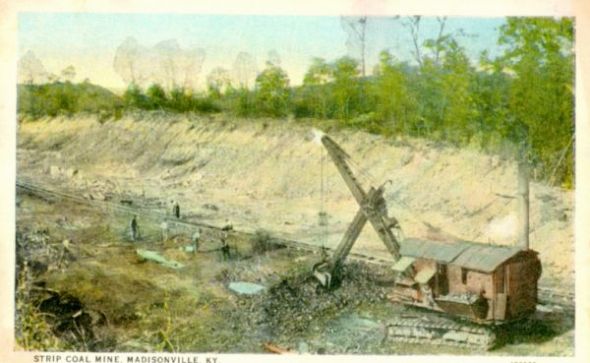
Postcard of a Stripmining Operation in Madison, Kentucky
(Courtesy Kentucky Coal Education)


Title: Kentucky Coal Education Web Site (to get into the site, you might need to click here)
Description: A whole slew of intriguing links, images, and so forth on, as you might suspect from the title, coal-mining in Kentucky.
Quote: Coal, 14 Cents

The Sweet Banner from hburgnews
Title: hburgnews
Description: Essentially, this is an "online community," combination blog, links, and happenings page. Completely groovy - like a window into the local political and economic universe that is Harrisonvegas.
Quote: It certainly seems that the city, Ritchie, and See are no closer to resolving the issue than they were three months ago. In the meantime, I’m sure drunken people will continue jumping the fence onto the faulty bridge.

Monday, January 29, 2007

Responding to Ms. Smiley

This morning we here at HS received an e-mail from a friend of ours, Mr. Rodger Cunningham. The byline was, “I swear this woman is serious. . . .” I clicked on the link and found this article on the site of The Huffington Post, and I have rarely been more insulted than when I read this article, and not just for Appalachians.

Smiley’s article reviewed a work entitled Albion’s Seed which attempted to elucidate the contributions, good and bad, of four of the original immigrant movements to the future United States political culture. The book explained, according to Ms. Smiley, that the primogenitors of our nation had for distinct perspectives on the nature of freedom. The “New England” perspective conceived of liberty as couched in communal interests, defined and limited by said community’s evolving mores. The “Cavalier” perspective (present, apparently, only in Virginia) conceived of liberty as a right exclusive only to a particular social class and gender. The “Pennsylvanian Quaker” perspective conceived of liberty as social and political tolerance. Interesting, if not entirely correct to anyone who understands the complexity of these cultures, even in their first two centuries and even if one forgets that numerous other cultural experiences are being completely excluded (for instance the influence of Iroquois constitutionalism, early Marylander and Carolina Jewish and French Huguenot contributions to religious tolerance and early Virginian conceptions of secularism that led it to be the first secular government ever – oh, and New York, New Jersey, Georgia, and the Carolinas apparently contributed, well, nothing) . What makes me grit my teeth, however, is the portrayal of the “Appalachian/Borderlands” perspective. Apparently, Appalachia, Scotland, North England, and Northern Ireland gave nothing to modern culture beyond violence and superstition.

Actually, let me quote Ms. Smiley. Because I can’t insult my own people well enough to get across her point. Ahem.

. . . the Borders/Appalachian culture of hot-blooded and violent populism that is xenophobic, religiously aggressive, fundamentalist, and sectarian, that is supicious (sic) of learning, antagonistic towards "elites", and antipathetic to women's autonomy. It defines itself by masculinity and arms-bearing, is belligerent by nature and quick to take offense. Its natural (and historic) enemy is the outgrowth of Quaker culture, liberalism.

You see, Appalachians (and apparently Scots and Irish, check that, Protestant Irish) and their cultural descendants (genetic or otherwise) hate people who are different from themselves, desire to assimilate all other religions, are fundamentalist (whatever that means), and sexist. Uniformly. We tote guns and think of ourselves as (I’m guessing this is the phrase Ms. Smiley really wanted to use) “bad @$$”. We like to fight and are easily insulted and are “natural enemies” of “liberalism,” which I can only take to be a veiled allusion to the democratic party.

I want to pause here and reiterate - I haven't read Albion's Seed yet, and from what I've read online by other writers, Fischer's work does not paint as generalized or insulting a picture as does Ms. Smiley - indeed, one of my earliest searches turned up this site on the University of Virginia's website (minor point - UVA's two campuses, Mr. Jefferson's in Charlottesville and its younger sibling in Wise, are both Appalachian, the former in the Blue Ridge and the latter in the highlands of the Appalachians main strand, near the Cumberland Gap).

The one part she did get right is that we, famously, are antagonistic towards elites – we are obsessed with, and this is insane, “individual freedom!” (please, insert scary ghost noise here)

Ms. Smiley goes on to point out how Appalachians were natural allies of the “Cavaliers” and that Appalachian culture is one far more obsessed with avenging affronts to culture, rather than dealing with issues according to conscience through rational action or conversation. She also points out that Gore was saved from his Appalachian-ness by being Washington bred, while Bush is a great example of Appalachia-via-Texas. Smiley even dismisses any influence Bush’s education at Yale might have had, while Gore’s Harvard education was apparently was a defining moment. EVERYTHING bad in America, from racism to the contemporary war in Iraq is the fault of Appalachian culture, and ultimately, Scottish culture.

Let me read you Ms. Smiley’s next to last paragraph before I conclude:

I do think that the rise of culture #4 puts our democracy in danger, simply because it is an uncompromising culture that has been reluctant to assimilate itself into the larger society for a thousand years, both in Britain and in America. It is a culture that is passionately intense about weapons, social hierarchy, and religion, three things that are in and of themselves threatening to the broader social compact. Perhaps culture #4 cannot be, or won't be assimilated, but can only be reduced, subdued, or dominated.

I can barely respond. Apparently the Cavalier culture has, by this point in the article, become completely immersed in the Appalachian culture (specifically, I refer here to the “social hierarchy” element), and the fact that Appalachians are (apparently) all fundamentalist Christians and violent monstrosities necessitates an internal crusade, the kind of wonderful social engineering that upperclass English (of centuries ago, not today - I'll not make the mistake of confusing the 17th and 18th centuries with the 21st) practiced against the Scots – you know, when they drove my ancestors off their farms and tried to destroy their traditions by suppressing their religion, their right to bear arms (oh, crazy me – I’m living up to Ms. Smiley’s stereotypes – I guess the Scots were horrible folk), and, heck, even they way they dressed. Gee – sounds great.

I want to respond to the historical inaccuracies of Ms. Smiley. I beg your indulgence.

First, Appalachia has never been a cultural ally of “Cavaliers” – the English aristocracy (and some members of the co-opted Scottish aristocracy) that planted itself throughout the Eastern Seaboard was universally antithetical towards socially and economically inferior groups. Does this still exist in the states it is most commonly identified with (specifically, Virginia, North Carolina, and South Carolina)? Surely it does. Do those persons who constitute this class, and it is a class, constitute more than five percent of any of these states? By no means – they are merely handy caricatures, you know like those constantly bandied about by, well, everyone, caricatures like – dramatic pause – like those levied against hillbillies. Oh, and before we assert that American aristocracy is a unique product of Virginia, one must ask, are wealth and entitlement that area’s exclusive progeny? From my reading of history, it seems clear that entitled merchant and banking classes had evolved in every single colony well before the American Revolution – New Englander “Mayflower” elites, for instance, are no more or less significant than Virginia’s “First Families” in the modern world.

Second, Appalachia, like the other frontier regions of the United States, was marked by higher levels of sexual egalitarianism than the Eastern Seaboard in the pre-modern era, not less. There is a reason that frontier states were sexually progressive well before the Twentieth Century – there, 19th Century liberal ideals blended with the pragmatic truths of frontier life – women had to share the frontier’s difficulties, and so knew they were men’s equals. English and Eastern Seaboard Victorianism was probably the largest deterrent to sexual egalitarianism coming earlier, rather than later Appalachian (or any other regions’) gender-bias.

By the way, I use feminist theory constantly in my research, and am married to a woman who kept her maiden name – a woman who was raised in the hills of western South Carolina. Golly garsh.

Third, Ms. Smiley asserts that Appalachians, not to mention their Scottish cultural kin, are culturally biased towards resolving their problems with violence. Thus we not only tend to be liberal (ahem) with our interpretation of the second amendment, but furthermore we have high levels of violence and support war in every instance. Wow. Painting with a wide brush, eh? How to begin. Let’s talk about some basic truths. Appalachia, and by that I mean the Appalachian Mountains, is marked by higher than average levels of economic underdevelopment (relative to the rest of our nation). I’m sure Ms. Smiley has heard of structural violence, but I want to bring it up for other folks. Structural violence is when a political-economic system preys on certain groups of people or confines them to limited political-economic opportunities. Structural violence, assert most social and political scientists, breeds structural violence – desperation results in desperation. The ghettos of cities like New York, Richmond, Chicago, Detroit, Boston, and dare I say it, Ms. Smiley’s beloved Philadelphia, exhibit this, for instance, but I daresay that Ms. Smiley would, wisely, be unlikely to assert that the impoverished of those areas (a veritable rainbow of ethnicities) are somehow culturally inferior to the rest of America in general, or her romantic image of Pennsylvania in particular. Similarly, Appalachia, bankrupted not by our own doing as much as by the machinations of coal companies from outside the region (particularly Virginia and the various and several Northern states), exhibits these traits. Perhaps the reason Ms. Smiley does not fear the violence of other types of ghettos is that they are, what were her words again? Oh yes, “reduced, subdued, or dominated.” Sounds like a cycle of violence perpetuated by a variant of colonialism, to me. It also sounds like puritanical pseudo-Calvinism, disgusting and arrogant, the kind of talk that justified Manifest Destiny and slavery. But that was a long time ago, wasn’t it? But then again, maybe this is just a case of blaming the victims, employed against the only group of Americans it remains politically acceptable to do so against. Who can say.

And do Appalachians “support” wars? Well, if by that you mean they volunteer for positions national defense at an incredibly high rate, despite living in what is one of the most secure regions of the nation, than yes. If by that you mean that, in the post-9/11 world they originally made the mistake of believing false or incorrect intelligent reports at a lower level than, I don’t know, CONGRESS (where virtually no members voted against the invasion of Iraq, including a great many folks who you’d be hard-pressed to argue are Appalachian or even “Appalachian-esque”) well, yeah. There is that.

Oh, and by the way, any amateur historian can tell you that Appalachia was not a Southern ally in the American civil war. Mentioning West Virginia in the Deep South once should eliminate any illusions to the contrary. Kentucky (birthplace of the good Mr. Lincoln), for instance, declared itself neutral, West Virginia experienced a sort of unique internal coup by which a huge chunk of the Commonwealth found itself torn asunder. East Tennessee had to be occupied by Confederate troops to prevent its rebellion. Appalachia, with its minimal dependence on the institution of slavery, can best be described as a region which described as a deeply split region – many folks supported the North and its ideals, many supported the South and its ideals of localism and regionalism, and many, probably most, were entirely ambivalent, more concerned with avoiding involvement in a war they had no strong feelings about either way.

Fifth, it should be said that Puritanical, fundamentalist religion is not a creation of Appalachia, especially as defined by Ms. Smiley, in the first order. Rather, it arrived in the future United States in 1620, with the Pilgrims, a people who came to American to establish, that’s right, theocracy. Appalachia and the South didn’t experience a rise in religiosity until New England-style revivals began penetrating the region en masse in the early 19th Century when the Second Great Awaking, coming to completion with the Third Great Awakening after the American civil war, a movement which also yielded the rise of high religiosity in large chunks of the American west. And, even now, religiosity is a mixed bag in Appalachia - the diversity of denominations is tremendous, particularly across the region as a whole. Trying to pigeonhole our religious identity is sort of like trying to pigeonhole the religious identity of any region or, their equivalent, major city in our United States - unwise.

As to why the cultural descendants of Appalachia fled the territory of Ms. Smiley’s idealized Quakers, well, let’s consider the foundation of Liberia. Liberia was, of course, founded in on the coast of west Africa, the settled by freed American slaves. The state was founded by two key groups – American slaveholders and Quakers. There were, of course, some idealistic motivations for this foundation – many white Americans, be they slaveholders or otherwise, felt that enslavement was horrible and immoral (which it was) and sought a viable solution. Other reasons were more pragmatic – fear among slaveholders, for instance, of violent slave uprisings. Or, in the case of many Quakers, a desire that everyone be free – as long as it wasn’t in their neighborhood. Now, don’t get me wrong – I don’t mean to stereotype and argue that this was the perspective of all Quakers, nor that it is an ideal present in contemporary Quakers of all genre – I respect a great many Quakers and their religion myself (theologically I'm what may be called a rationalist Methodist). But the Quakers were people who had founded a place and wanted it to remain the way they founded it, without freed slaves or Scots-Irish, for instance. I guess it comes down to my reminiscence of how Scots-Irish, like many of my ancestors, often recount their story of coming to America. They lived in Scotland till they fled seeking individual freedom, economic improvement, and religious freedom. They settled in Ireland, not out of any particular antipathy to the Irish (a culture very similar to their own), but because it was offered to them by the Crown. Ultimately, as English and Scottish aristocrats once again clenched down on the Scots-Irish, many of them fled to other corners of the world, seeking still freedom and economic independence. Some of these fled to Australia, New Zealand, and Canada, while others fled to the Pennsylvania colony, where they were originally welcomed with open arms. Once there, however, the, ahem, aristocrats who made executive decisions in the Pennsylvania colony soon found that with numbers came power, and began "encouraging" the Scots-Irish to settle other territories - too many refugees, essentially, for comfort (we might call them illegal immigrants today). They soon found themselves in moving up and down the Appalachian Mountains, filling valleys and setting up on mountaintops from Newfoundland to Alabama. There they hid, because their history, from the beginning of their cultural memory, was one of exploitation. And it worked – they became yeomen farmers, by and large, save those who stayed in the mountains and found themselves coerced or tricked out of their lands by coal companies, who doubled the sin by trapping them in a cycle of debt.

Earlier I referred to Ms. Smiley’s romanticism. This is the pervading theme of her diatribe. Appalachia, and Appalachia’s culture, is her real-life Heart of Darkness or Dracula’s Transylvania, while wealthy, Democratic-party dominated America is her Victorian London – proper and modern and forward-thinking. Appalachia is to be feared as a virus – we are an internal “Yellow Peril,” defined primarily not by race, though genetic heritage is obviously part her construct, but by her own stereotypes. Appalachians are universally white, fundamentalist (read as politically active social conservative), violent, undereducated, racist, sexist, and uncultured, according to Ms. Smiley. This is a grotesque caricature, as grotesque as those which portray us as barefoot, stupid, cousin-marrying, slackjawed, fools. The argument carries no more water than those who argue that secularism is a Northern/West Coast conspiracy, or those who argue that crime is essentially nothing more than a product of some inherent element of African American culture. It is disgusting, it is prejudiced, and it is offensive.

I could go on, bring up points like our role in the American Civil Rights Movement, the role of the Scotsmen in the Enlightenment, or even the simple truth of the fact that Appalachians are a minority in every state we’re found in, except West Virginia. Not to dismiss Ms. Smiley’s fears – I too detest unnecessary violence and efforts to restrict religious freedom/undermine secularity, and I know Appalachia is a place with tremendous room for political and economic improvement. But I suggest that the situation is far more complex than she thinks. I’d recommend, in particular, that she reads Kevin Phillips’ American Theocracy or Daniel Boorstin’s Pulitzer Prize-winning The Americans trilogy. . . . perhaps then she'll learn that elegant explanations of the world's problems are usually based as much in fantasy as in fact.


Apologies for the rant.