Saturday, May 06, 2006

Picture from Mike, Part II

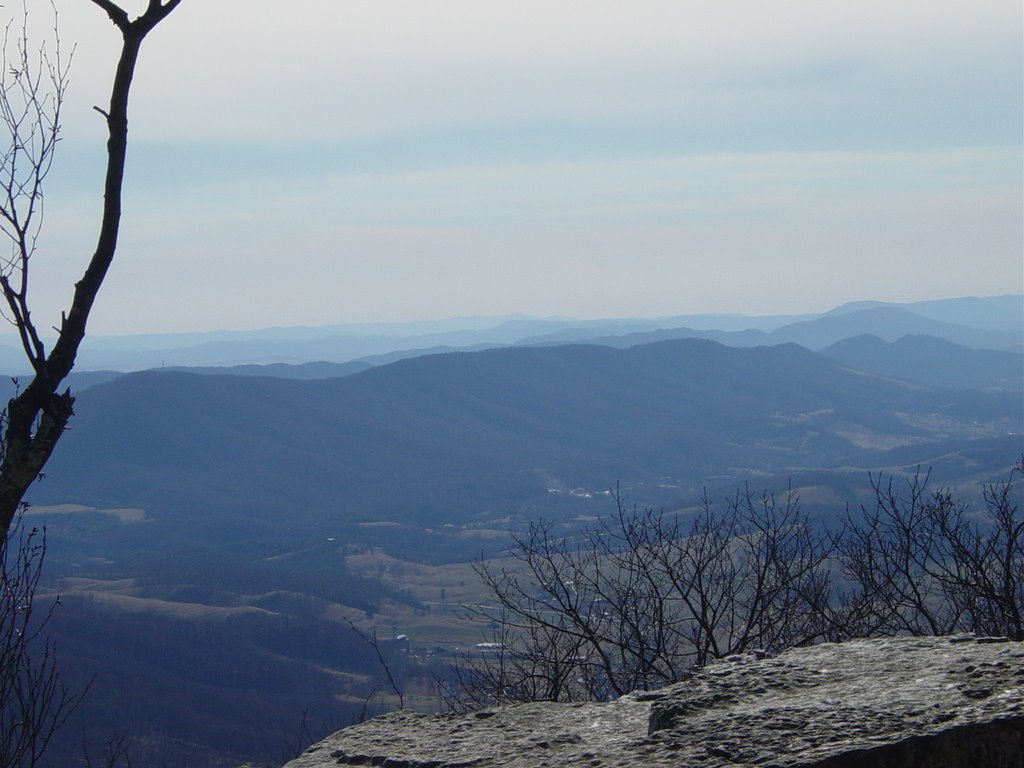
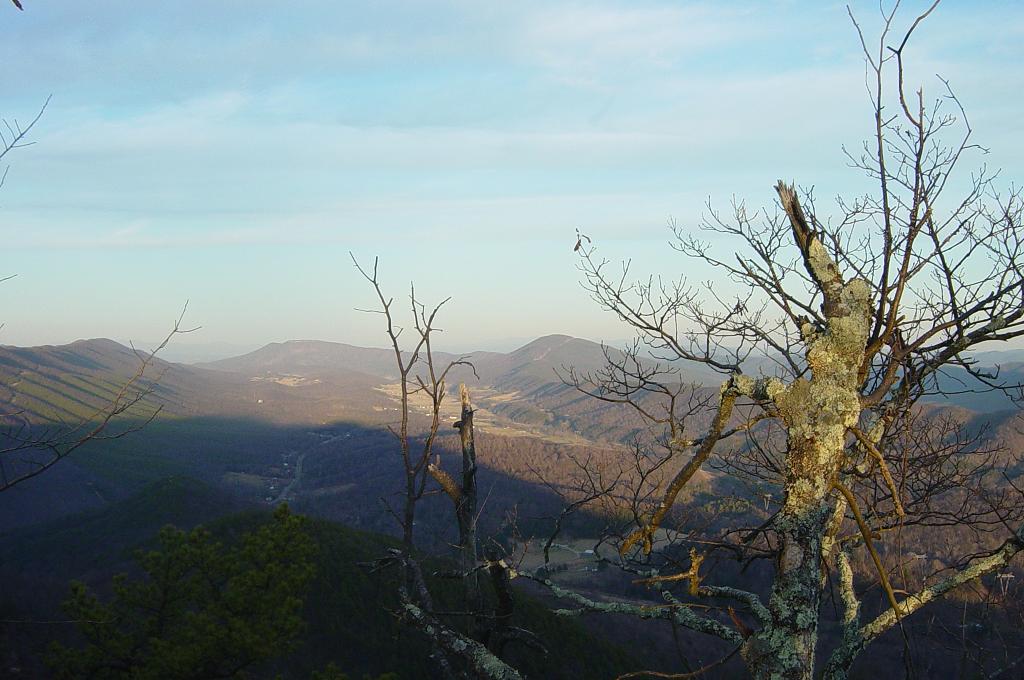
This is the view from Kelly's Knob, on John's Creek Mountain, along the Appalachian Trail at the Giles / Craig County line. Here, you're looking to the southwest, across Giles, Bland, Pulaski, Wythe and even into Floyd, Carroll and Smyth Counties. I ran into an old grizzled hiker at this lookout who said that on a clear day you can see Mount Rogers and Whitetop Mountain in Grayson County. If you click on the picture, the furthest ridge that you can see on this hazy day is part of the Iron Mountain Ridgeline in Smyth County, near the Mountain Empire Airport, I think. For another look, click this panorama picture that a thru-hiker posted.
And here we're at the parking area for the A.T. crossing. I guess the Big Mountain Hunt Club needed something to use for target practice so in exchange for the sign, they'll pick up their shell casings and beer cans four times a year.

A Streetcar Named Desire


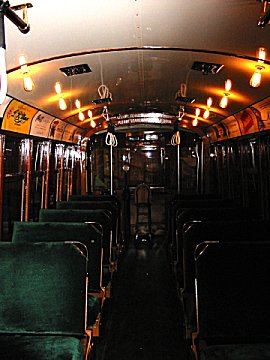
Ok, that was cheesy, but oh well. It seems as though some of the more interesting things to be seen are easily missed when you walk by them all the time. This is the way it was with this particular piece of the collection of the East Tennessee History Center, one of my places of employment. I had always seen it there, I walked in and out if it whenever I was at work, but I never really sat down and enjoyed it as a piece of Knoxville until today, when I snapped this photo of its interior after closing up the museum. Streetcar #416 of Knoxville, circa 1940. Number 416 has been beautifully restored to its condition when it was in operation on the streets of Knoxville. Complete with green velour seats, hardwood and polished brass trim, and brite yellow and white paint, this piece of art-deco engineering might seem more at home in New York or San Francisco than an Appalachian city. Too bad we no longer have such modes of transportation in this traffic-laden town.

Cocke County, Tennesseee

The Knoxville News-Sentinel's website has developed a standing, evolving timeline of corruption in Cocke County, Tennessee. It opens like this:

Welcome to Cocke County.

For generations of East Tennesseans, this mountain community of 35,000 people has borne — fairly or not — the reputation as the region's capital of vice and corruption.

Local leaders have tried mightily to overcome this image, focusing instead on victories on the fronts of industrial development and tourism. But old habits die hard, and recent events show that many of the same practices that once earned Cocke County the nickname of "Little Chicago" still flourish in the hills and hollows that border the North Carolina state line.

Federal and state authorities have been targeting the county for at least four years, deploying everything from undercover agents to helicopters and SWAT teams to support an investigation that has reportedly turned up a dizzying array of criminal activities: drug trafficking, chop shops, the hijacking of interstate shipments, organized gambling, prostitution, fraud, attempted money laundering, racketeering and public corruption.

The ultimate scope and targets of the probe, which is known unofficially in government circles as "Operation Rose Thorn," are still unknown. At the heart of the investigation thus far have been allegations of corruption in the Cocke County Sheriff's Department, but a major fund-raiser for Gov. Phil Bredesen named Harold Grooms has also emerged as one of Rose Thorn's targets. The sheriff's department suffered a series of embarrassing blows in 2005 as five officers were indicted on federal charges, and longtime Sheriff D.C. Ramsey, a Republican, resigned after it was disclosed early this year that he was a target of an FBI inquiry into illegal gambling operations involving video poker machines and cockfighting. Public records obtained by The News Sentinel have also revealed possible connections between members of Sheriff Ramsey's family and a host of convicted drug dealers, car thieves and alleged cockfighters who have been implicated in the probe as well as ties to businesses that have been raided by state and federal agents.

Ramsey's nephew and chief deputy, Patrick Taylor, was arrested with his brother, Jarrod Taylor, just before Christmas for allegedly conspiring to traffic in thousands of dollars worth of stolen NASCAR merchandise and is awaiting trial. Another deputy has admitted in federal court to sidelining as an armed cocaine dealer; a second officer has pleaded guilty to taking part in a scheme to smuggle drug money to Miami; a third officer has pleaded guilty to stealing money from a drug suspect during a traffic stop; and a fourth has been convicted of perjury and witness tampering.

The county's other law enforcement agency, the Newport Police Department, hasn't been immune to allegations of corruption: two sergeants are awaiting trial on charges of shaking down a pair of Hispanic men during a traffic stop.

Since the probe began about four years ago, criminal charges have been filed against more than 170 people as state and federal agents have cracked down on vice and associated crimes through a series of raids that shut down two brothels and the Del Rio Cockfighting Pit, which has been described as one of the largest illegal gambling facilities in the Southeast United States. Search warrants have also targeted a number of taverns, homes, garages, a video amusement company, and a downtown flower shop.

This isn't the first time that Cocke County has found itself in the crosshairs of the FBI. Many of the individuals who have recently been accused of illegal activities have been in trouble before, sometimes in connection with previous allegations of misconduct leveled against law enforcement officials.

One prosecutor has said the current probe represents the "last gasps" of an outlaw tradition that began generations ago, and it appears that the first acts of the drama now unfolding in Newport and Del Rio may have begun in the 1960s, when D.C. Ramsey was a young constable elected to patrol the roads of one of East Tennessee's roughest areas.

That said, the Sentinel has put together a detailed summary of that "outlaw tradition." It is definitely worth ten, twenty minutes, especially if you're living in Tennessee and are unconvinced that major reform isn't necessary.

Bluegrass Lyrics

This one, put simply, is really for Steve Long.

Think of it like this - there are a plethora of lyrics (specifically Bill Monroe, Flatt & Scruggs, the Stanley Brothers, Jimmy Martin, the Carter Family, the Delmore Brothers, and the Louvin Brothers, to name a few) collected here, as well as a pseudo-plethora of links (including several other lyrics pages).

Henry Queen & The Family Queen

I'm not going to write too much here about the Queens, not because there isn't much to say, but because I'd rather you peruse their site yourself. They are, from all I've seen, a family of musicians perserving and playing traditional mountain music. Of course, when they say traditional mountain music, they're not implying that they only play older songs, but in fact that they play only music meeting the criterion of traditional, pre-bluegrass mountain music. You'll like it or you won't, I suppose, but its a refreshing sort of music, the kind that makes you feel genuinely content - I'd call it evening music, the kind you listen to either by a fire when its very cold or on the porch when its just the opposite.

That said, they're also responsible for a crazy sort of music that combines techno sensibilities with bluegrass and mountain music in the form of the Smoky Mountain Drum n' Bass. It is sorta' insane - I can't even describe it. I lack the words.

Regardless, really dig in and explore - there are many, many samples. Its worth a few minutes to get acquainted with a what might be called a royal family.

God, such a bad joke.

Wind Farms

This morning the Roanoke Times ran an interesting story about a proposed wind farm in southwest Roanoke County, along the Blue Ridge. The story mentions Poor & Bent Mountains as sites for the towers. Poor Mountain is already decorated with antenna towers from the Roanoke TV and radio stations as well as the ever present cellular tower. Bent Mountain backs up the Blue Ridge Parkway and the valley between the two ridges has become more and more popular for developers. This should be a nice debate to watch unfold if the farm concept looks like it could actually happen.

Encyclopedia of Appalachia

I decided to post this here first, before I throw it up on the other blog. . . the choices we must make.

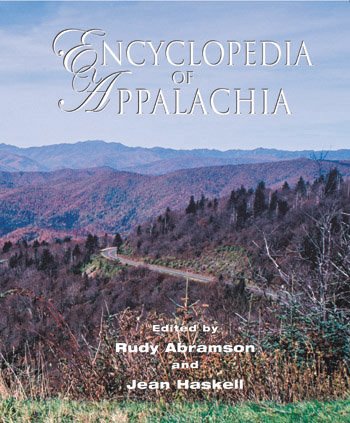
For my birthday my Dad went out of his way this year. . . put some serious thought into it and bought me one of the coolest books I've ever owned . . . The Encyclopedia of Appalachia. Damn straight he did. Let me review it in the simplest terms.

One, the book is one of those tomes you find yourself flipping through constantly. . . definitely has that "coffee table" thing working for it. And even though, in many ways, it is definitely an academic repository of knowledge, formally approached and executed, it feels like you could sit down and read the whole thing straight through, despite the fact that it has quite enough heft to it to bring down a rampaging water buffalo - in other words, non-academics shouldn't shy away from it for fear of its size or the letters behind its creators' names.

That said, I hope that this edition is merely a first edition - there is much, much room to expand upon things. In particular, it would be invaluable to address the numerous municipalities and other governmental bodies in a wholly inclusive way, describing their history, economy, etc. . . this is a huge task though, and I can imagine why it wasn't tackled. Also, only a few higher educational institutions receive press time - Emory & Henry, my alma mater, gets a sentence - if the book's intention is truly to, as its authors insist, not only aid in Appalachian social, historical, and political scholarship but further to address blatent discrimination which the region is subjected to, showcasing our excellent schools (e.g. E&H, Maryville, Berea, Mars Hill, Concord, West Virginia Wesleyan, Washington & Lee, VMI, not to mention the various research institutions like Kentucky, Virginia Tech, Tennessee, West Virginia, Marshall, James Madison, UNC Asheville, and so on) would go a very long way towards that end.

That said, the Encyclopedia is worth the green in my humble opinon. . . but heck, at $80 you may disagree. If so (or if not, frankly) I strongly encourage you to, well, strongly encourage your public or school library to acquire a copy or two for their reference section. So it is.

Friday, May 05, 2006

Hillbilly Odyssey

Although I hesitate to make my first contribution in the form of a shameless self-promotion, I'm doing it.

For the last week, I've been traveling across the United States. From Knoxville to Nashville, Memphis to El Paso and points beyond. It's been an incredible experience -- one I should have had years ago.

The trip isn't purely recreational, though. I'm traveling with my good friend, Jay, who is relocating to Ft. Irwin in Barstow, California.

Jay is in the Army. And he's a lawyer.

Beware the trained killer who will defend himself at his own trial.

The two of us are Greene County boys, raised in the woods of Romeo, Tennessee. Since leaving the nest, our travels have taken us to dramatically different places. I've been to Central America, Europe, and even Ohio. Jay's pretty well-traveled, too. But I don't keep up with where he's been.

That said, neither of us has ever made a trek across the nation like this. Everything we've seen, West of Little Rock, is new to us. Geography, wildlife, ethnic populations, driving habits. Everything.

I'm writing this having now reached our penultimate destination: Barstow, CA. All that's left is for us to voyage up along the Grand Canyon to Las Vegas so I can get on a plane and return home. Throughout the trip, I've kept a photographic record of our travels. And so, my first contribution to Hilbilly Savants is that travelogue:

An Hillbilly Odyssey.

There is more to come soon. If you find yourself interested in this odyssey, return to find out how it ends.

Passenger Rail Service?

1957 saw the last running of the Norfolk-Western daily passenger steam locomotive train from Roanoke to Bristol. From 1942 until this last excursion, N&W had powered it's steam fleet with the cutting edge J Class locomotive. In 1950, the rail shops in Roanoke turned out the infamous 611 (two more were built after this model). It was the most powerful locomotive to date, harnessing over 5,200 horsepower onto 70" driver wheel. For the next seven years the 611 was a daily visitor for the folks in the valley between the Blue Ridge and Allegheny ridges. People in Shawsville would hop on the train and chug up the line to Vickers Switch, to start their day of work at the Radford Arsenal. Or ride from the community of New River to Pulaski for pocket change.

Several years after the diesel engine replaced the steam powered train, passenger service to Appalachia was discontinued. N&W had merged with the Southern Railway Company to become Norfolk and Southern. The company decided that continuing passenger rail service clogged up the rails with trains that could be hauling freight instead. Enter the end of private corporation / "public" transportation in SWVA. N&S decided years later in 1982 to bring out tourist excursion stream rides a few times a year, to the delight of small towns that the trains once stopped in. I have a few pennies that were flattened by the 611 near Dublin sometime in the mid-to-late 1980's. Radford was a water refill point for the steam locomotives so there was always a large crowd of photographers and on lookers in my hometown. My house was a few miles away from Downtown but you could always hear the pressurized steam whistle echo off of the hills when the excursions past through town each summer. That is, until 1994 when, once again, N&S decided to scrap the program. Luckily for Roanoke, and the rest of us, the 611 was donated to the Virginia Transportation Museum. Today you can get a good look at the machine up close and personal, and probably looking as good as is did coming off of the assembly line in 1950.

So, is there a need to return a passenger rail service to the most traveled corridor of Appalachia? Many people would say yes just based on today's fuel prices. Many local governments agree for reasons of economic development, so much so that over the past few years that the concept of the Trans Dominion Expressway has received the endorsement from Gov. Warner, Congressmen Boucher and Goodlate and has the drawn the interest of Norfolk and Southern. Unfortunately, Virginia Gov. Tim Kaine isn't as interested in the TDX as Warner but hopefully that will change in his tenure. What what I've heard from him in his speeches, he seems to be of the mindset to pave our way out of a transportation issue on I-81 other than look at other alternative solutions to the rolling tire but time will tell. Also, the movement seems to have lost steam if you look at the website. The last update is July of '05 which leaves me wondering if the initiative has stalled. Anyone with insight feel free to follow up...

Thursday, May 04, 2006

Picture from Mike, Part I

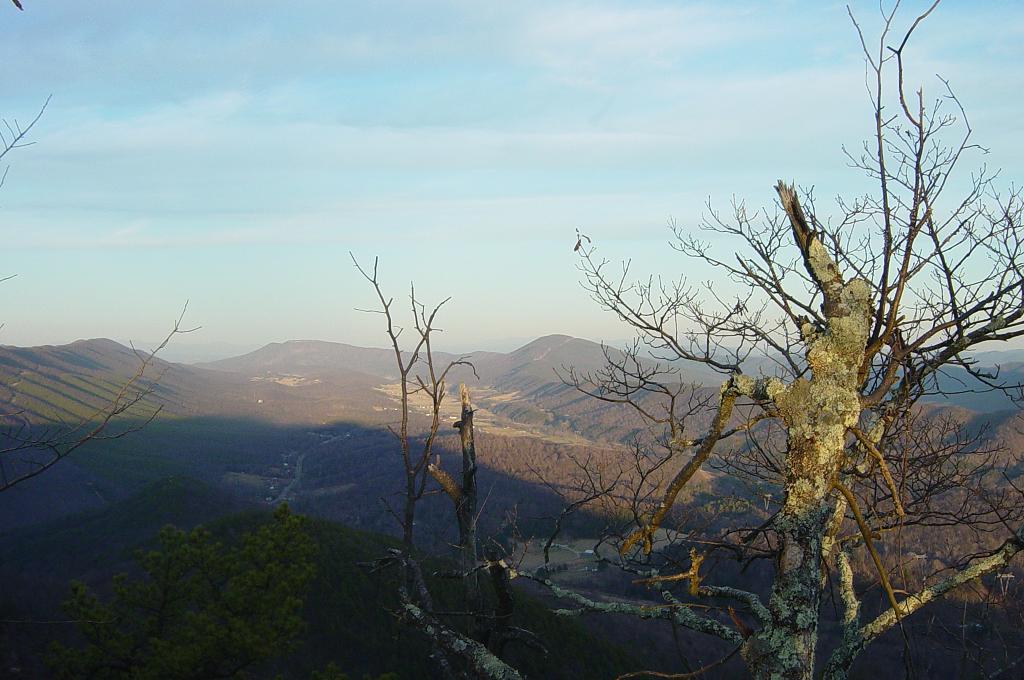
Over the past few years I've become somewhat of a shutterbug. So, here's a picture of the mountains for your viewing pleasure...You're looking from the Appalachian Trail near Dragon's Tooth over the Catawba Valley of Roanoke County, Va. Salem is just over the mountain "hump" to the center-right of the picture. North Mountain and Craig County are to the far left.

White Lightenin'


What better way to follow up a post about Mountain Dew but with its dilutee, Moonshine.

As I type this, the Blue Ridge Institute at Ferrum College, in Franklin County, Va. (self proclaimed "Moonshine Capitol of the U.S of A"), has an exhibit on the history of moonshine and its roots in foothills of Southside Virginia. Unfortunately, the website is not up to date with its exhibits but this gallery just opened the first part of May and will run for a while so check back often if you aren't able to make it to Ferrum in person.

As for my own personal moonshine / mountain dew story, we have to hop in the way back machine and set the dial for the summer of 1998. That is when Neal, Tori, Olivia and myself ventured to the Mill Creek Cabin (Smyth County, Virginia). To cut to the action, the four of us were enjoying our grilled animal and potatoes when we hear a mountain man howl down the holler from us. Naturally, we howl back. After a few back and forth shouts we hear a car coming up the road toward us. Car doors slam and three folks hop out of the car, one holding an empty gallon jug, the other a few plastic bags and the third held a half gallon bottle of Jim Beam in each hand, only it was filled with a clear liquid. No, this wasn't JB Crystal. After introductions, Neal knew one of the dudes from high school so all was cool.

These folks decided to share a recipe with us that brings the history of Mountain Dew and 'shine full circle to today's world. As we watched with anticipation, this skinny ragged dude poured an exact pint of shine, a package of Kool-Aid (pick your favorite flavor), one 1/4 of sugar and filled the rest of the empty gallon jug with what else but Mountain Dew. After two batches, split between 7 people, we were howling at the moon! Somehow, I ended up with a bruise of a 6x6 post across my chest that evening, apparently from trying to catch myself after I had fallen from the porch. But that was our only problem, none of us had any morning complications from the Dew as it was as clean brewed as a mountain spring.

Most people that have never had white lightenin' have a negative connotation of the beverage, probably formed from stereotypes seen on television. For those that have participated in the ritual of passing a jar around, they will tell you that there is no better bonding experience, even if just for the evening, as what will transpire after taking part in a mountain communion.

Mountain Dew

On my other blog I have never gotten as many responses to a post as I did to my post on soda pop. That's right. Soda pop.

I decided my first entry here should be on one dimension of the soft drink universe, specifically the magical beverage known as Mountain Dew. I'm not going into alot of details - you don't need 'm I'm sure, but I am putting in some good stuff.

The homepage of Mountain Dew is okay, a little too "extreme" for my humble tastes, but such is life - it does, however, give us the official history of the yellow-green liquid. Arguably the best unofficial site, the site that will utterly drown you data and images, is MountainDewBottles.com, though the Mountain Dew Collector (home of the Dew Times) site ain't bad either.

Here's the MetroPulse history of the Dew, the urban legend about Dew's effect on man-potency, a blog entry which mentions the term "It'll Tickle Your Innards," a list of mixed drinks with the Dew at their core (76 at the time of posting), and a basic, cut and dried history of their ad campaigns.

Things to keep in mind? Names on bottles, the fact that this is a moonshine mixer, and the phrases "belly-washer" and "yahoo." Dig.